GIGATAGE
James johnson-perkins
ABOUT
GIGATAGE
PLAXIS
INTERMADES
VIDEOSTALGIA
SHOP
BIOGRAPHY
& archive
 These Gigapan/Montages are vast digital panoramas in which historical and contemporary figures converge within globally recognisable sites. Structured by themes, these works operate as immersive visual archives, referencing figures such as Canaletto, Bosch, Constable, Cage, Confucius and Schopenhauer while combining panoramic scale with intense detail.
SELECTED GIGATAGE IMAGES
VENICE/CANALETTO/THE GREAT BATTLE
KATHMANDU/RAPHAEL/THE ASSEMBLY OF THE GODS
NEW YORK/BOSCH/TIMES SQUARE NUDE
MOSCOW/SCHOPENHAUER/MOTHER(IN LAW)LAND
KUALA LUMPUR/BRUEGEL/KUALA AMPROCENE
BEIJING/CONFUCIUS/THE THREE WISE MONKEYS
DEDHAM VALE/CONSTABLE/THE ZONE
BRIGHTON/GERICAULT/RAFT OF THE BRIGHTONIAN
LIVERPOOL/NEOLITH/SCOUSE HENGE
ANGKOR/DARGER/REALMS
ISTANBUL/ZEID/SIGNS AND SYMBOLS
BERLIN/CAGE/BERLIN AI-CHING
JAIPUR/SINGH/JAIPUR GALORE
PARIS/SUSKIND/PARIS KISSES
SOUTHAMPTON/KURITA/SOUTHAMPTOMOJI
NINEVEH/MARTIN/VICE AND VIRTUE
GIGATAGE ESSAYS
The Great Battle
VENICE/CANALETTO
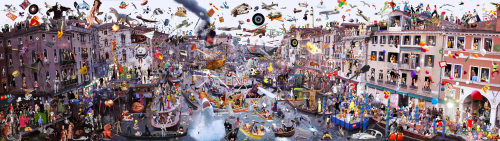
The Great Battle, After Canaletto, Venice, Italy, 7m x 2m, 2014–23
A monumental digital collage that stages an epic clash between the characters of childhood, The Great Battle unfolds across a fantastical version of Venice, echoing Canaletto’s luminous canal-scapes. Here, the serenity of Venetian architecture becomes the stage for chaos: hundreds of figures drawn from decades of popular culture, superheroes, toys, cartoon villains, converge in an allegorical confrontation. Divided along ethical lines, characters on the right represent kindness, compassion, and innocence; those on the left embody menace, cruelty, and domination.
This dreamlike fray does more than celebrate nostalgia, it exposes how media embeds ethical binaries in our collective childhoods. The work resonates with Stuart Hall’s insight that popular culture is “one of the sites where this struggle for and against a culture of the powerful is engaged” (Hall, 1997, p. 239), revealing the moral dialectics beneath the surface of childhood fantasy. In evoking Canaletto’s precision and theatricality, the piece also echoes his own reflections on illusion and spectacle: “My intention is always to give a faithful representation of reality, even when it appears incredible” (Canaletto, quoted in Links, 1977, p. 15).
References:
Hall, S. (1997). Representation: Cultural Representations and Signifying Practices. Sage Publications.
Canaletto, quoted in Links, J.G. (1977). Canaletto. London: Phaidon Press, p. 15.
The Assembly of the Gods
KATHMANDU/RAPHAEL
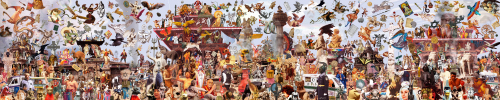
Assembly of the Gods, After Raphael, Kathmandu, Nepal, 10m x 2m, 2012–23
This image draws direct inspiration from Raphael Sanzio’s The Council of the Gods (1518), reimagining the classical divine summit as a chaotic, transcultural, hyper-detailed spiritual congress. Set within the sacred architecture of Kathmandu’s Patan Temple complex—a UNESCO World Heritage site, the work assembles an overwhelming array of gods, prophets, saints, spirits, and mythic creatures from across time, space, and belief systems. Hindu deities converse with Buddhist monks, Egyptian gods stand beside Christian saints, while esoteric symbols and animist spirits thread the space in a reverent, visual polyphony.
What emerges is a monumental “uber-spiritual conference,” a celestial parliament negotiating the ruptures of contemporary existence. The digitally collaged scene, saturated in luminous hues and layered with pixelated intricacies, embodies both homage and rupture. Raphael’s harmonious Renaissance composition is here exploded, pluralised, and imbued with the post-digital condition. Like Raphael’s dream of divine concord, this work aspires toward unity, yet acknowledges the fragmentation of globalised spirituality. The collision of religious iconographies and cultural epochs affirms David Morgan’s observation that sacred imagery in the modern age exhibits a “multivocality” that reflects the hybrid, porous nature of belief in a globalised world (Morgan, 2005, p. 95). Raphael once wrote, “Art is a harmony parallel to nature” (Raphael, 2000, p. 122). Assembly of the Gods reinterprets that harmony as discordant resonance—a fractured, sublime effort to gather the divine fragments of a splintered world.
Created both before and after the devastating 2015 earthquake that struck the square, the work resonates with the tension between cultural resilience and fragility. The earthquake’s shadow lingers in the fractured, layered composition, echoing the physical and spiritual upheaval experienced by the region, and underscoring the precarious balance between destruction and the enduring sacred.
References:
Morgan, D. (2005). The Sacred Gaze: Religious Visual Culture in Theory and Practice. University of California Press.
Raphael, quoted in Jones, J. (2000). Raphael: A Passionate Life. London: Random House, p. 122.
Times Square Nude
NEW YORK/BOSCH
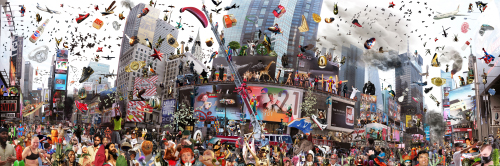
Times Square Nude, After Bosch, New York, USA, 4.5m x 1.5m, 2012–24
Times Square Nude, After Bosch is a panoramic digital montage that channels the surreal, grotesque sensibility of Hieronymus Bosch into the epicentre of modern hyper-capitalism, Times Square. Over 4.5 metres wide, it teems with monstrous figures, warped advertisements, and absurd hybrids of celebrity, technology, and desire. Like Bosch’s The Garden of Earthly Delights (c.1500), the work presents a nightmarish tableau of indulgence, delusion, and decay. Naked bodies and brand logos intermingle, exposing not just flesh, but the raw mechanics of a system that devours both image and identity.
In the spirit of Mark Fisher’s theory of “capitalist realism”...the notion that capitalism so thoroughly occupies the imagination that alternatives seem impossible, the piece stages a visual overload in which alienation becomes spectacle (Fisher, 2009). Dissent is commodified, and pleasure slips into a kind of aestheticised despair. Bosch’s haunting observation echoes through this contemporary fever dream: “Poor is the mind that always uses the inventions of others and invents nothing itself” (Gibson, 1973, p. 21). Here, invention lies in reassembling the debris, visual, ideological, corporeal, of a culture that’s lost its moral coordinates.
References:
Fisher, M. (2009). Capitalist Realism: Is There No Alternative? Zero Books.
Gibson, W.S. (1973). Hieronymus Bosch. Thames and Hudson.
Bosch, H., quoted in Gibson, W.S. (1973), p. 21.
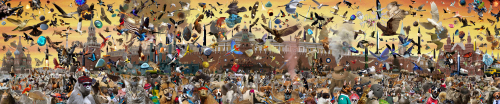
Mother(in Law)land
MOSCOW/SCHOPENHAUER
Mother(in-law)land, After Schopenhauer, Moscow, Russia, 4.8m x 1m, 2014-24
Mother(in-law)land is a monumental anti-war scene that reimagines Moscow as a surreal battlefield of conflict, will, and wildness. In this fractured cityscape, costumed and chaotic animals gather in Red Square, taking the place of fallen ideologues and fading armies. Above them, birds and nuclear projectiles cut through an apocalyptic sky, where butterflies, missiles, and balloons share the same chaotic airspace. The towers of the Kremlin, once symbols of control, now are vulnerable and targeted, besieged by conflicting natural and philosophical forces.
Arthur Schopenhauer’s idea of the world as “will and representation” pulses beneath the surface, playing out in a tension between entropy and animal autonomy. Hope and destruction collapse into one another in this stark homage to ‘Ark’ Images of the past. Here, the absurd mimics the real: animals parody the humans whose world they now inherit. This tension between chaotic natural forces and human will echoes Schopenhauer’s assertion that “the world is my representation,” where subjective perception and the blind striving of the will shape reality (Schopenhauer, 1819/1969).
References:
Schopenhauer, A. (1969). The World as Will and Representation (E. F. J. Payne, Trans.). Dover Publications. (Original work published 1819)
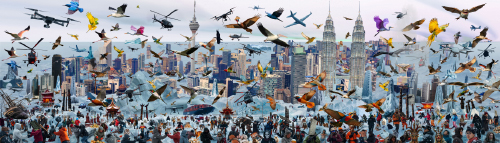
Kuala Amprocene
KUALA LUMPUR/BRUEGEL
Kuala Amprocene, After Bruegel, Kuala Lumup, Mayalsia, 3.5m x 1m, 2025
A cold, marginal city unfolds where figures move through a strained urban landscape of limited shelter, resources, and stalled mobility. The scene becomes a site of ecological and geopolitical pressure where survival replaces symbolic or playful meaning. Fragmented infrastructure, abandoned vehicles, and suspended movement suggest systems of progress in partial collapse, echoing the labouring stillness of Pieter Bruegel the Elder’s The Hunters in the Snow (Bruegel 1565).
Within this field, a distant burning structure sits against the cold atmosphere, suggesting the coexistence of spectacle and crisis. Domestic remnants such as frozen pumpkins appear as displaced everyday objects, now residual markers of disrupted consumption. Birds move low and erratically across the sky, while drones circulate above as quiet systems of observation.
Harbour structures hold partially frozen ships, their forms suspended within a slowed environment where water and time appear temporarily arrested. Human, animal, and machine exist within a shared unstable climate, where meaning emerges through adaptation rather than fixed order.
The work can be read through the Anthropocene, a proposed epoch in which human activity becomes a dominant geological and environmental force shaping climate, ecosystems, and material conditions. Here, the city is not separate from climate but embedded within it.
Atmospheric scientist Kevin Trenberth notes that “the climate system is now being driven in ways that are outside the range of natural variability” (Trenberth 2018), a condition reflected in the work’s moderated instability, where weather functions as an active structuring force rather than background context.
References
Bruegel P (1565) The Hunters in the Snow. Kunsthistorisches Museum, Vienna.
Trenberth K (2018) Climate change caused by human activities is now influencing the weather. Nature Climate Change.
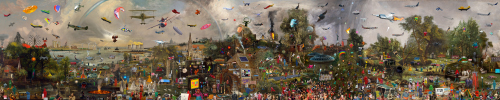
The Zone
DEDHAM VALE/CONSTABLE
Coming soon
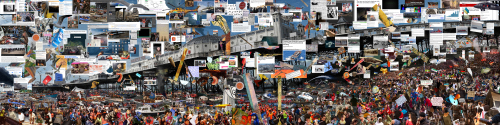
Raft of the Brightonian
BRIGHTON/GERICAULT
The Raft of the Brightonian, After Géricault, Brighton, UK, 6m x 1.5m, 2011–24
A vast digital montage set against Brighton’s East Pier, The Raft of the Brightonian draws direct influence from Théodore Géricault’s Raft of the Medusa (1818–19), recontextualising Romantic catastrophe within a contemporary frame of displacement, media saturation, and humanitarian crisis. Constructed over thirteen years, the work collages hundreds of photographs of refugees, protest banners, digital screenshots, news clippings, and art historical fragments. The pier becomes a scaffold for visual overload, crowds march, boats flounder, and fragments of text scream across the surface. It is both epic and intimate, ordered and chaotic.
This teeming visual sea captures the tension between survival and representation, between lived trauma and its media echo. As Ariella Azoulay writes, such an image acts as “an archive of potential history... assembled not as a completed past but as a claim for a different future” (Azoulay, 2019, p. 41). The work holds open a space of reckoning, fragmenting time and image into a montage of exile and endurance. Théodore Géricault’s own words haunt the piece: “I have to astonish, I have to disturb, I have to make people feel” (Géricault, 1983, p. 214). The Raft of the Brightonian embraces this imperative—an ethical call to witness and remember, in pixels and protest.
References:
Azoulay, A. (2019). Potential History: Unlearning Imperialism. London: Verso.
Géricault, quoted in Eitner, L. (1983). Géricault: His Life and Work. London: Orbis Publishing, p. 214.
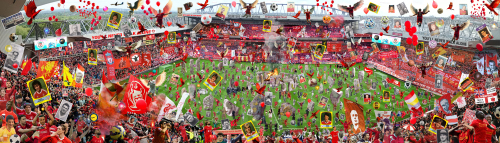
Scouse Henge
LIVERPOOL/NEOLITH
Coming Soon
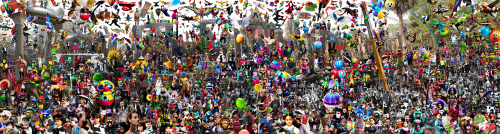
Realms
ANGKOR/DARGER
Realms, After Darger, China/Cambodia, 5m x 1.2m, 2023
This phantasmagorical panorama merges digital and geographical extremes to conjure a surreal, hybrid world. Inspired by the outsider artist Henry Darger, the work seeks to evoke a childlike, ethereal vision that is also deeply uncanny. The composition’s upper half was captured using a Gigapan camera in the ancient ruins of Angkor Thom, Cambodia, allowing for immense detail across the sprawl of temples and jungle. The lower half is constructed from a similarly large-scale image of the Terracotta Army in Xian, China, its solemn rows now interrupted by a riot of colour and digital characters. Overlaid upon this layered historical foundation are hundreds of AI-generated figures. Some emerge directly from Darger’s visual language, little girls in battle uniforms, fantastical creatures, while others feel absurd, kitsch, or oddly dislocated, complicating any single reading of the scene.
The strangeness of Realms lies not only in its uncanny fusion of disparate historical and cultural landmarks but in the way it reconfigures digital imagery and AI-generated entities into an unsettling, dreamlike realm. The AI figures, algorithmically derived yet seemingly imbued with narrative suggestion, blur the boundaries between human creativity and machine invention. This coexistence of human history and artificial fabrication destabilizes the viewer’s sense of time and place, engendering a liminal space where mythic pasts, contemporary technology, and outsider art converge. The image’s uncanny effect is heightened by the oscillation between hyperreal photographic detail and the eerie artificiality of its digital inhabitants, some playful, some menacing, all evoking a fractured narrative identity. In this way, Realms embodies Hal Foster’s assertion that “we live amid images without bodies and bodies without images” (Foster, 1996, p. 146). The work visualizes a fractured presence, a terrain where the synthetic and the organic, the real and the imagined, coalesce and conflict, inviting reflection on how AI and digital reproduction transform our perception of history and memory.
Reference:
Foster, H. (1996). The Return of the Real: The Avant-Garde at the End of the Century. MIT Press.
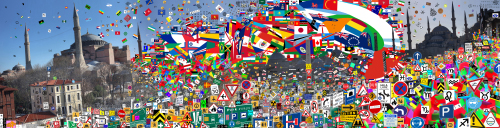
Signs and Symbols
ISTANBUL/ZEID
Maps, Signs and Symbols, After Princess Fahrelnissa Zeid, Istanbul/Turkey, 7.34m x 1.88m, 2024
This panoramic digital work overlays a dense constellation of global maps, signs, and symbols onto a Gigapan image of Sultanahmet Square in Istanbul, where the Hagia Sophia and Blue Mosque loom on either side like guardians of a chaotic present. Drawing inspiration from Princess Fahrelnissa Zeid’s Break of the Atom and Vegetal Life (1962), the image echoes her fusion of abstraction and emotion, yet updates the palette with a symbolic deluge: national flags, road signs, emojis, internet icons, and warning markers cascade through the composition like a digital Babel. Stretching 7.34 meters wide, this piece replicates the fragmented poetry of Zeid’s visionary forms by substituting organic brushstrokes with the hard-edged logos of our modern existence. Istanbul becomes both stage and symbol, its historic skyline submerged beneath a semiotic flood, reflecting the visual noise of a hyperconnected, overstimulated world.
As Zeid once said, “I am a descendent of four civilisations. In my self-portrait, the hand is Persian, the eye is Byzantine, the dress is Bedouin, and the heart is Ottoman” (Zeid, 2015, p. 42). Her words resonate through this work, where multiple identities and histories collide in a tapestry of coded abstraction. The result is both lyrical and disorienting, a dreamlike topography that maps out the collision of identities, languages, and cultures. Viewers are invited to navigate this sprawling visual system, where meaning and confusion coexist, just as in Zeid’s abstraction, the spiritual and the atomic, the vegetal and the cosmic, find uneasy harmony (Shabout, 2015).
References:
Shabout, N. (2015). Fahrelnissa Zeid: Painter of Inner Worlds. London: Tate Publishing.
Zeid, F., quoted in Shabout, N. (2015). Fahrelnissa Zeid: Painter of Inner Worlds. London: Tate Publishing, p. 42.
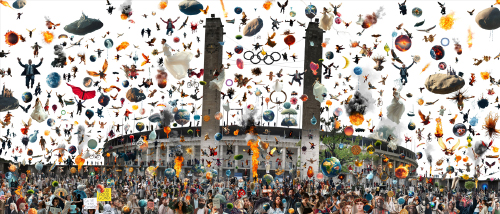
Berlin AI-Ching
BERLIN/CAGE
Berlin AI-Ching, After John Cage, Berlin/Germany, 4.67m x 2m, 2025
Berlin AI-Ching, After John Cage is a vast digital montage that fuses historical resonance with algorithmic futurism. Set against a Gigapan image of Berlin’s Olympic Stadium, a structure heavy with ideological weight, the work swarms with AI-generated figures, symbolic objects, and surreal interventions inspired by the 64 hexagrams of the I Ching. Each figure and object were created through artificial intelligence, embodying a divinatory principle, like fragments of fate raining through space and time.
The piece mirrors John Cage’s embrace of randomness, echoing his strategies of chance operation through a visual language of chaos and complexity. Cage’s own words resonate here: “I can’t understand why people are frightened of new ideas. I’m frightened of the old ones” (Cage, 1961). This work also relates to generative art, as theorist Philip Galanter notes, “generative art refers to any art practice where the artist uses a system… that is set into motion with some degree of autonomy” (Galanter, 2003, p. 4). Berlin AI-Ching embodies this principle, transforming Cage’s aleatoric ethos into a generative visual form. Explosions, floating castles, falling brides, burning globes, and birds in flight swirl around the stadium’s towers, confronting the viewer with a disorienting, sublime atmosphere. The crowd below, diverse, watchful, engaged, acts as witness to this collapse and rebirth of meaning.
Berlin AI-Ching invites viewers to question authorship, authority, and the elusive patterns of truth within an age of synthetic vision. Here, ancient Eastern philosophy intersects with AI and 21st-century machine learning. This tension between control and surrender, destiny and choice, speaks to our current cultural condition, caught between the mechanical and the mystical, the coded and the human.
References:
Cage, J. (1961). Silence: Lectures and Writings. Wesleyan University Press.
Galanter, P. (2003). “What is Generative Art? Complexity Theory as a Context for Art Theory.” International Conference on Generative Art, Milan, Italy.
Jaipur Galore
JAIPUR/SINGH
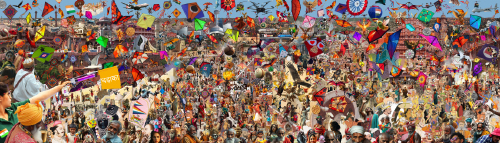
Jaipur Galore, After Sawai Jai Singh, Jaipur, India, 7.4m x 2m, 2025 (Commision for Jaipur Art week)
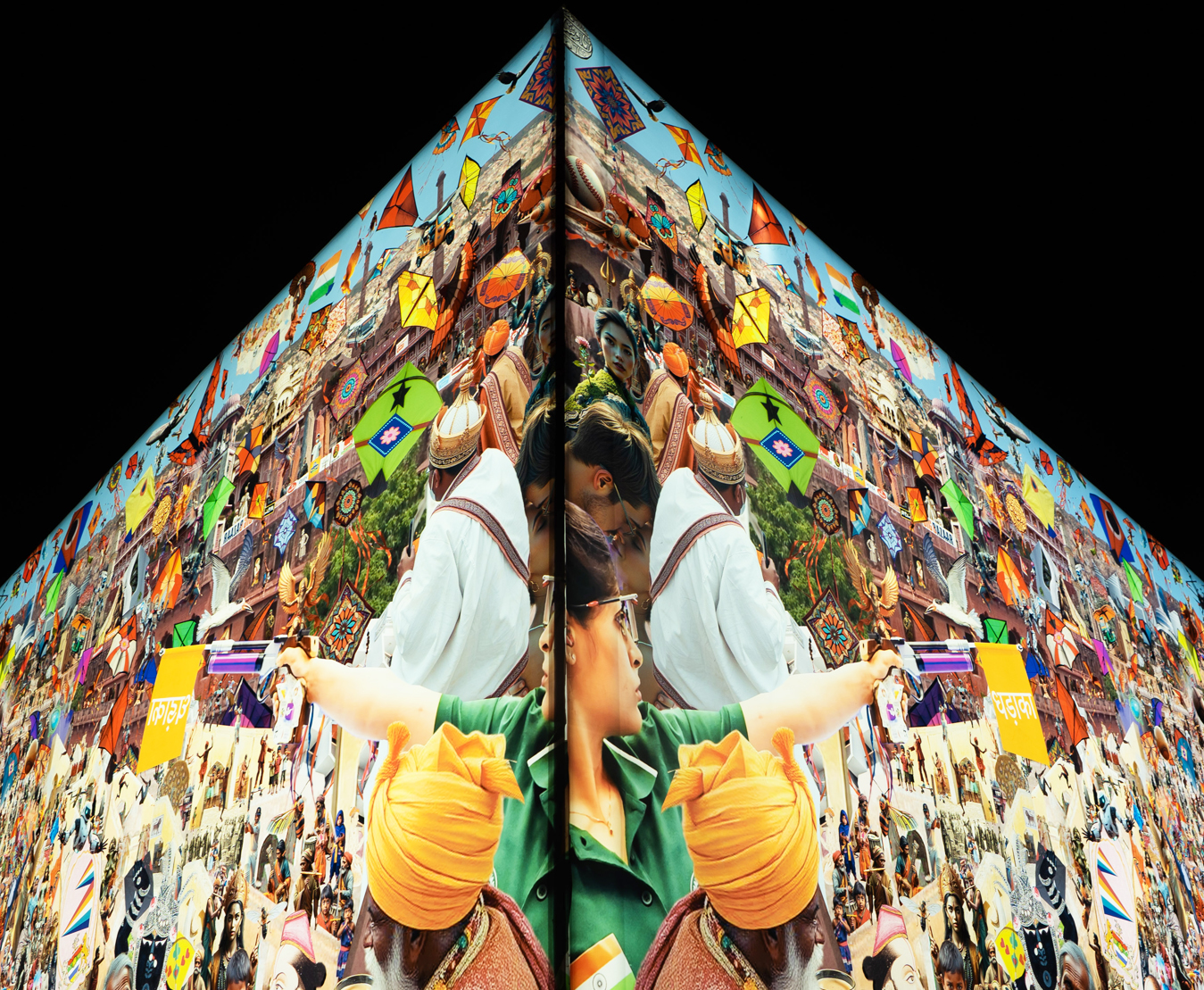
This behaves like a vast cosmology of the city, part festival, part archive, part visionary map. Sawai Jai Singh, Jaipur’s founder, shaped the city through astronomy, mathematics, and Vedic metaphysics, and this artwork extends that lineage by weaving Hindu astrology directly into its visual logic, populating the composition with AI-generated figures drawn from astrological archetypes. These futuristic characters intermingle with figures from Rajasthani miniature painting and contemporary images of Jaipur’s royal lineage, collapsing centuries of visual culture into a single dazzling field. The huge scale becomes essential: only a surface of this magnitude can contain the dense flow of kites, gods, robots, warriors, vendors, royalty, and digital avatars spiralling through a shared urban sky. Traditional pink-hued architecture brushes against drones and satellites; courtly figures from miniatures appear beside twenty-first-century Jaipur elites; celestial beings drift over street performers and pilgrims. The city emerges not as a fixed location but as an unfolding mandala in which urban planning, mythology, and digital futurism remain in constant dialogue. Created as a commission for Jaipur Art Week 2025, the work functions as both homage and transformation, extending Jai Singh’s original astronomical vision into a post-digital era. It becomes a kaleidoscope of Jaipur’s layered identities, where heritage and hypermodernity collide in exuberant abundance. As Jai Singh himself observed, “From the first dawning of reason in his mind... he was entirely devoted to the study of mathematical science” (Kaye, 1918), an ethos that pulses through the artwork and guides its synthesis of history, cosmology, and contemporary imagination.
References:
Kaye, G. R. Astronomical Observatories of Jai Singh. Calcutta: Superintendent Government Printing, 1918.
Paris Kisses
PARIS/SUSKIND
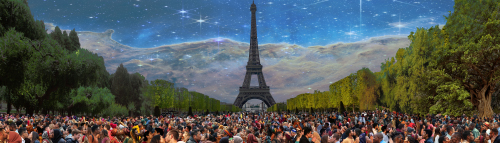
Paris Kisses, After Süskind and Webb, 7.4m x 2m, 2025
This single panoramic artwork gathers thousands of intimate gestures into one vast, continuous field. Created using AI image searches for “people kissing” in every country in the world, the work assembles a global tapestry of affection: couples from every continent and culture, brought together into a densely layered human mosaic. The Eiffel Tower rises at the centre of this panorama, cutting upward into a breathtaking cosmic sky derived from a single James Webb Space Telescope (JWST) image. This same celestial field stretches across the entire scene—behind the tower, over the treetops, and into the far right where a huge, ancient tree dominates the landscape. The work juxtaposes earthly tenderness with astronomical immensity, creating a dialogue between human closeness and cosmic scale. The piece draws conceptual inspiration from Patrick Süskind’s Perfume, especially its idea of constructing the sublime from countless fragments. Süskind writes: “He wanted to create an exalted scent… composed not of one, but of many essences” (Süskind 1986: 183). In Paris Kisses, this becomes a visual alchemy: the artwork gathers individual kisses, each a small, private moment and reassembles them into a single overwhelming sensory experience.
The reference to “Webb” acknowledges the James Webb Space Telescope, whose imagery reshapes our understanding of the universe. As NASA describes it: “Webb reveals the cosmos with unprecedented clarity, allowing us to see where stars and galaxies are born” (NASA 2022). This idea resonates deeply with the artwork’s structure: a cosmic backdrop that frames and elevates the human multitude below, suggesting that our most intimate gestures unfold within a universe far older, stranger, and more expansive than ourselves. At 7.4 metres by 2 metres, Paris Kisses immerses the viewer in a planetary portrait of affection. It meditates on global intimacy, sensory overload, and the fragile, luminous connections that bind humanity together beneath the cold grandeur of the stars.
References:
NASA (2022) James Webb Space Telescope: First Images Release Statement. NASA, 12 July.
Süskind, P. (1986) Perfume: The Story of a Murderer. London: Penguin.
Vice and Virtue
NINEVEH/MARTIN
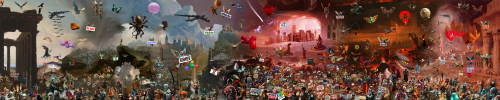
Coming Soon
NASA/GIGAPAN TECHNOLOGY
These giant digital images are epic landscapes of modern and historical figures in renowned sites and civic squares, including: The Rialto Bridge/Venice, Times Square/New York, Red Square/Moscow, Patan Square in Kathmandu and Brighton Pier.
By carefully selecting and positioning the figures based on different themes: Ethics, Religion, The Uncanny, Refuge and War, Johnson-Perkins creates Taxonomies of these narratives, which in themselves explore history, identity, and place. These works also connect with iconic historic artists, specific artworks and thinkers, which are reflected in the GIGATAGE titles such as: Canaletto, Raphael, Bosch, Gericault, Schopenhauer and Confucius.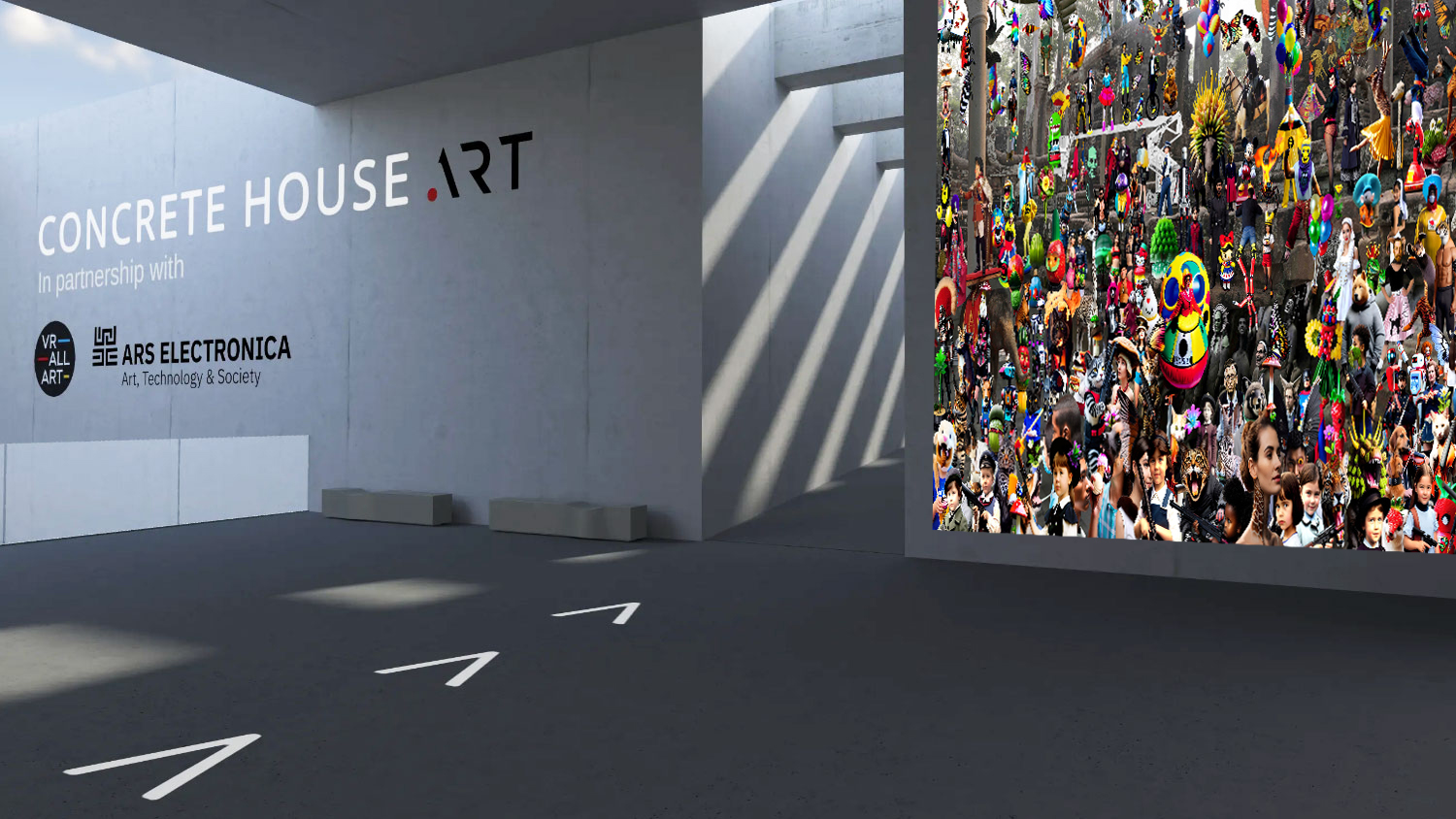
Realms, Concrete House, Ars Electronica, Linz, Austria
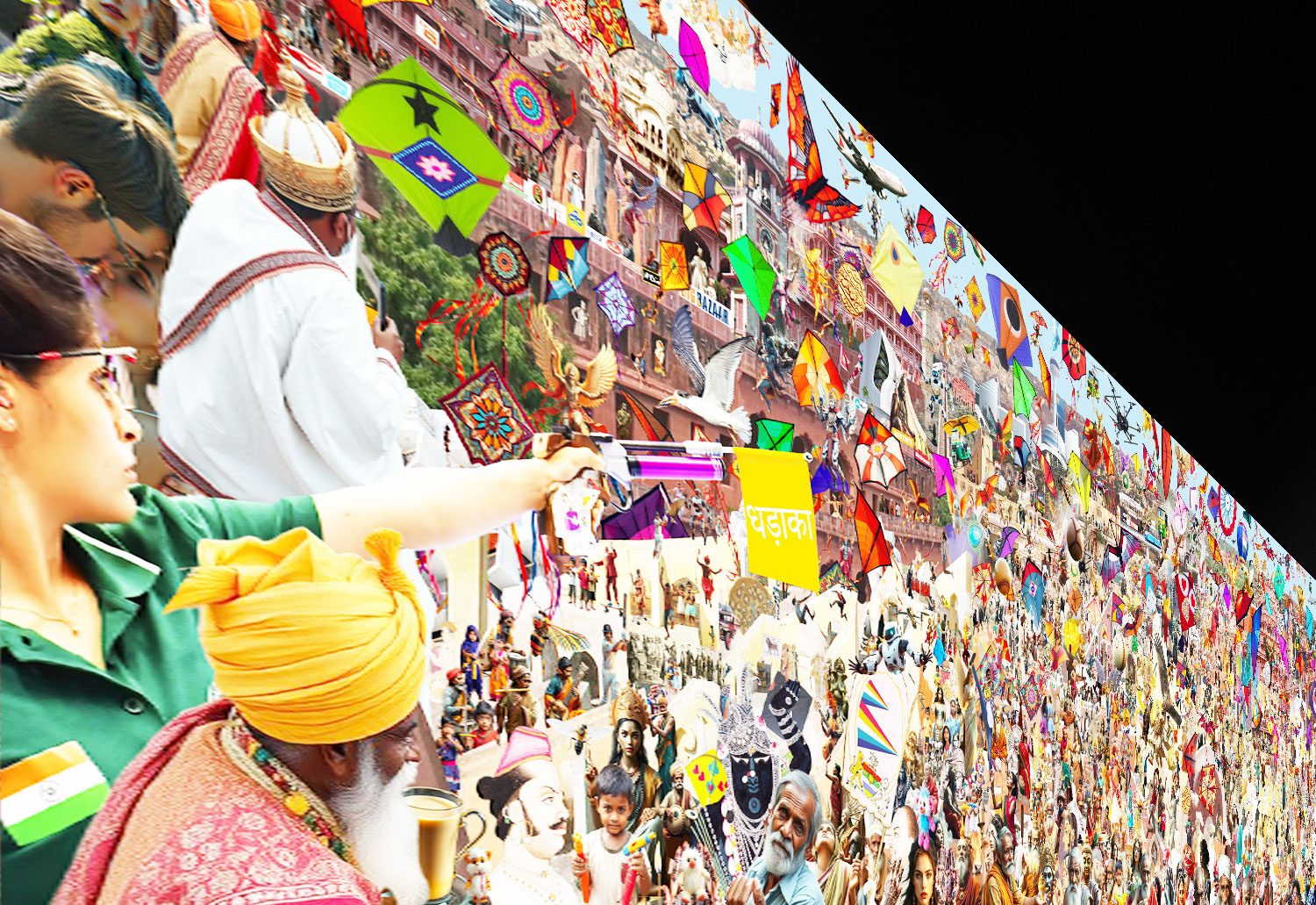
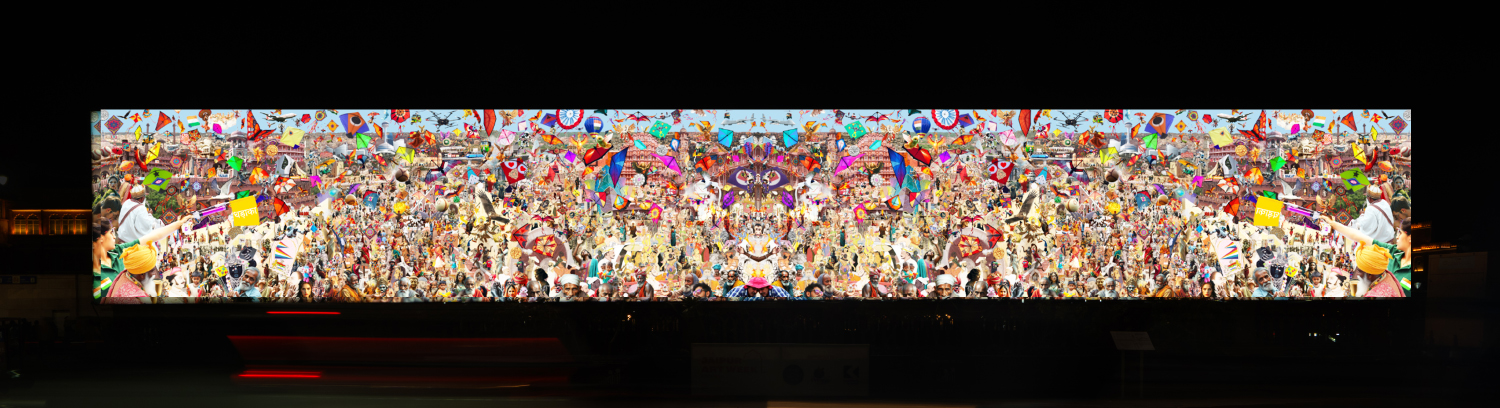
Jaipur Galore, (400 Meter Square) Lightbox Installation, Jaipur, India
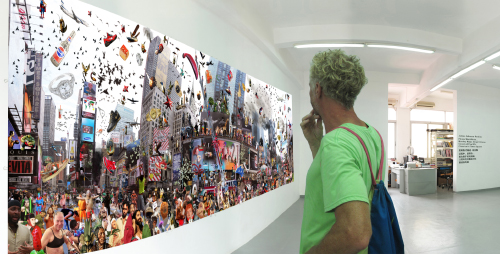
Times Square Nude, Chinese European Art Centre, Xiamen, China.
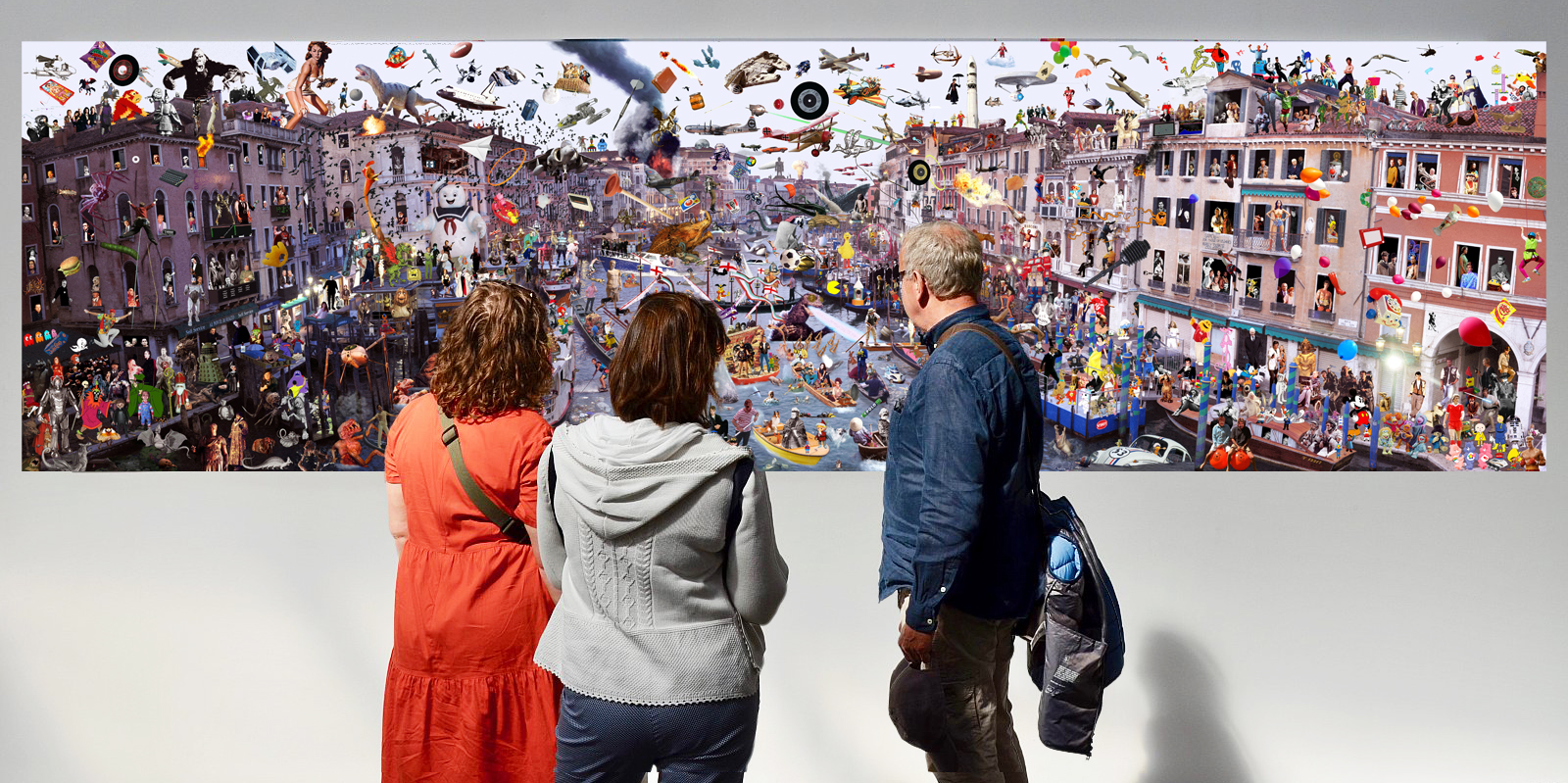
The Great Battle, Nord Art, Büdelsdorf, Germany
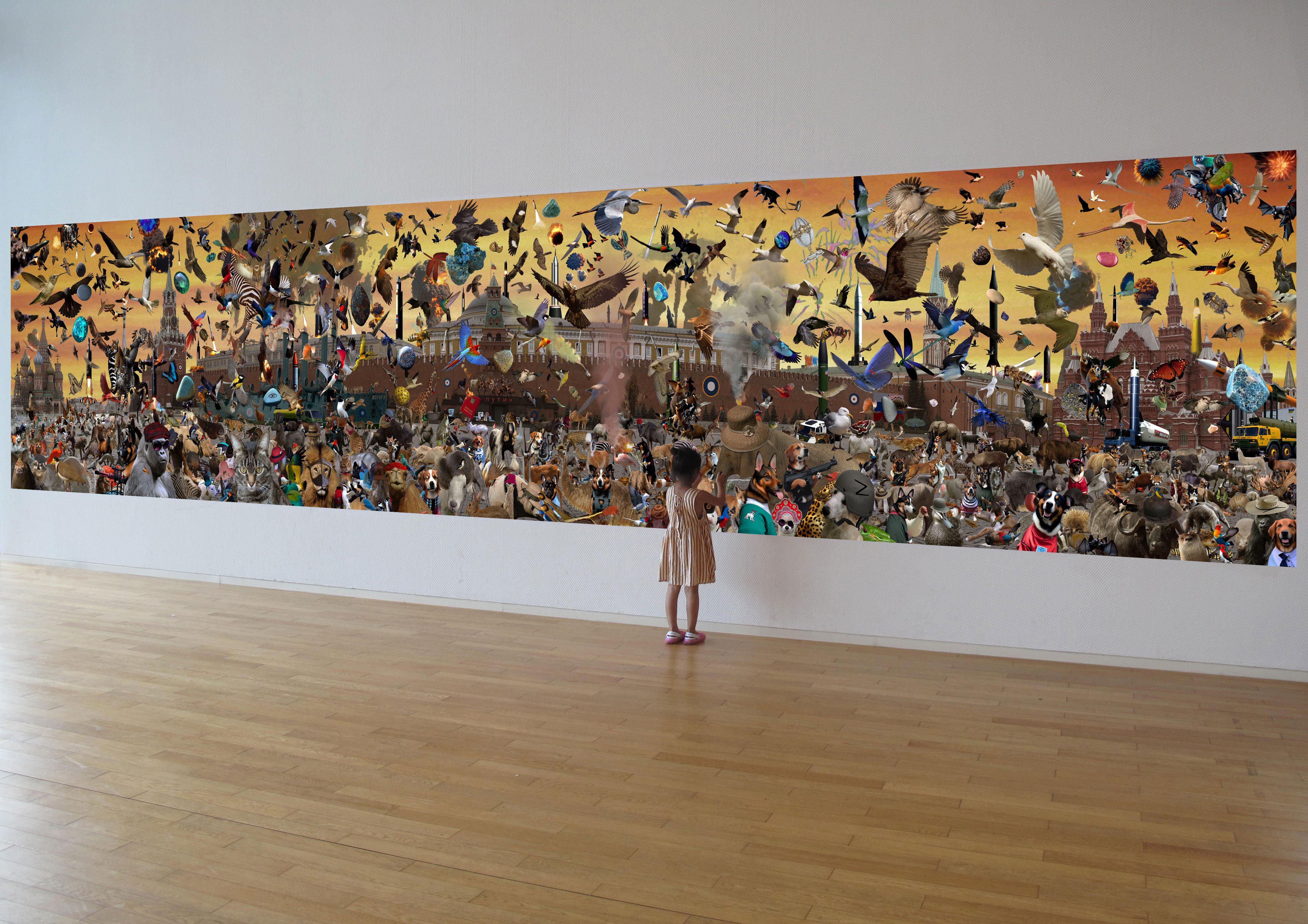
Mothe(In law)land, Liangzhu Culture Centre, Hangzhou, China
GIGATAGE TITLE IMAGE Jaipur Galore, Detail, 2026