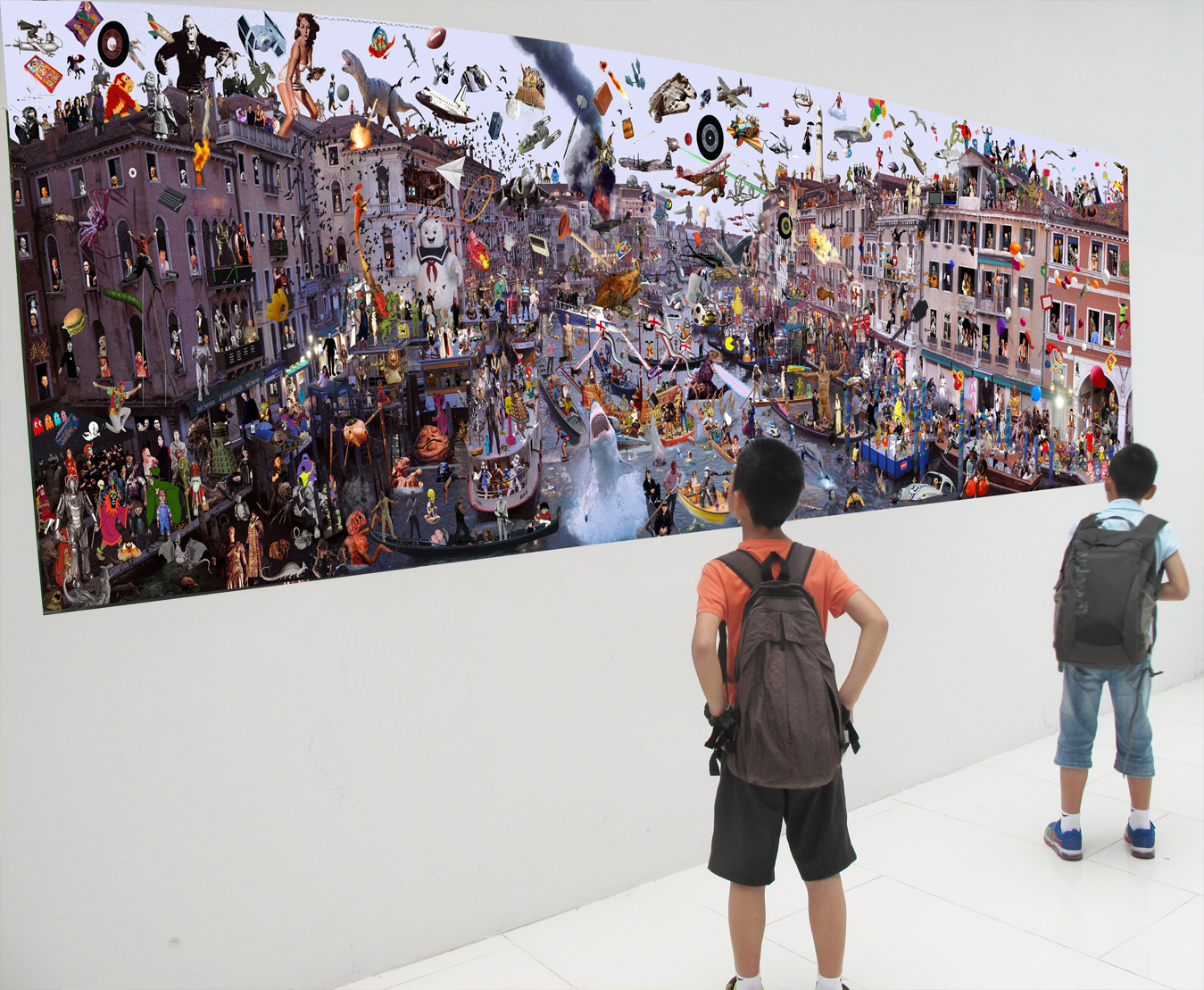
James johnson-perkins
Johnson-Perkins has exhibited widely across Europe, Asia and the Americas, including presentations at Ars Electronica in Linz and twice at the Venice Biennale, and his recent inclusion in Jaipur Arts Week (2026) signals the continued expansion of his international presence.
His exhibition history spans experimental and institutional contexts, including The GenAI Summit at ArtX Gallery and The Palace of Fine Arts in San Francisco, Post Digital Reality at the Video Art International Festival in Austria, and Nord Art in Germany. Further presentations include The Emily Harvey Foundation (Venice), The Royal College of Art (London), The Centre for Contemporary Art (Glasgow), The Chinese European Art Centre (Xiamen), Toyota Museum of Modern Art (Japan), Czong Institute for Contemporary Art (South Korea), The Patan Museum (Kathmandu), Austin Museum of Digital Art, and The Arts Students League (New York).
Johnson-Perkins has been involved in over 50 group events and he has exhibited alongside a huge variety of international artists including: Alison Knowles, A-YO, Ben Voutier, Gustav Metzger, Sean Scully, Littlewhitehead, Andre Stitt, Michael Nyman, Bill Drummond, Bob and Roberta Smith, Vlad Monroe, Gabriela Fridriksdottir, Alan Kane, Matt Stokes, Matthew Cowan, Robin Klassnik, Juneau Projects, Ross Sinclair, and Antony Gormley.
Residencies
Johnson-Perkins has participated in numerous international artist residency programmes, including The British School at Rome (November 2019), The Emily Harvey Foundation in Venice (2010, 2014, 2017), The Chinese European Arts Centre (2015), The Bridge Guard Residency in Štúrovo, Slovakia (2010–2011), the Kathmandu Contemporary Art Centre Residency at Patan Museum in Nepal (2012), and the Vytlacil Campus Residency at The Art Students League of New York (2012). In 2024/5 he was the artist in residence at Merz, Scotland and Le Maison De Barbara, Ayvalik, Turkey, and in 2021 Johnson-Perkins was involved with two residencies at The Belgrade Arts Studio, Serbia and Correlation Contemporary, Peru.
Gallery and Educational Work
In 2006/7 he was the Director of Novellus Castellum, an art organisation, in Newcastle/Gateshead, UK. This organised a two-year program of arts events and curated a large exhibition space in a disused warehouse in the East End of Newcastle. Novellus Castellum was also part of the Curatorial Biennale at Apex Arts, New York, USA. Aug 2007. (www.novelluscastellum.blogspot.com)
In 2006 he was also a co-founder of Newcastle’s The Star and Shadow, Cinema. This is one of the leading UK independent cinemas, which has been written about extensively in the UK national press. As well as being instrumental in the set up of this venue, He also, over 5 years, curated here, a series of artist video anthologies, film events and exhibitions. (www.starandshadow.org.uk) In the UK, he has worked as a Lecturer at Gateshead College (www.gateshead.ac.uk) and a Fellow at Northumbria University (www.northumbria.ac.uk) and as a Freelance Arts Facilitator at The Baltic Centre for Contemporary Art. (www.baltic.art) Internationally
Johnson-Perkins has worked in the Middle East as Course Director of BA Fine Art at the Scientific College of Design, Oman (www.scd.edu.com), in 2011–12. Between 2012 and 2014, he worked as Pathway Leader for the Foundation Fine Art course and as a BA Fine Art Lecturer at the British Higher School of Art and Design (also known as Universal University), Moscow, Russia (britishdesign.ru/en).
From 2014 to 2022, he was a Senior Tutor for Content A (CELE) and Module Convener for Art and Design courses at the University of Nottingham Ningbo, China (www.nottingham.edu.cn/en). He was also a visiting lecturer at Xiamen University, China (www.art.xmu.edu.cn).
Johnson-Perkins currently works on the Art and Design courses at Oncampus, Winchester School of Art, UK, and is a visiting tutor at Arts University Bournemouth. He has also recently worked as a Gallery Ambassador at the John Hansard Gallery, Southampton, UK.
GIGATAGE
James Johnson-Perkins lives and works in the UK and China
James Johnson-Perkins is an acclaimed British award-winning artist who currently lives and works in the UK and China. Johnson-Perkins has exhibited in leading venues in Asia, North America and Europe, Including: Toyota Museum of Modem Art, Toyota City, Japan, The Art Museum of Nanjing University of the Arts, Nanjing, China, The Arts Student League, New York, USA, Ars Electronica Centre, Linz, Austria, The Centre for Contemporary Art, Glasgow, Scotland and The National Centre for Contemporary Arts, Moscow, Russia.
He recently won the Mediterranean Contemporary Art Prize, President's Award and the Bath Open Prize, People's Choice Award. He was the runner-up for the Alpine Fellowship, Visual Arts Prize, and he was an award winner for the Art Observatory Digital Art Program, Ukraine/UK. He was also a finalist for the' Air/and 4.0 I Nature, Technology, Energy' Competition, and he was shortlisted for the Passpartout Photo Prize, Italy.
In 2021, Johnson-Perkins was involved with two digital residencies at The Belgrave Aris Studio, Serbia and Correlation Contemporary, Peru and his work was also recently shown at the Rotterdam Photo Festival, Holland, Florence Contemporary Gallery, Italy, Austria, Festival Nacional Performance Art de Buenos Aires, Argentina, The International Forum of Performance Art, Drama, Greece, and at Ars Electronica with. ART Gallery VR, Linz, Austria.
Due to living in China and in the United Kingdom address the direction of your current artistic research?
James Johnson-Perkins: I studied in Newcastle-upon-Tyne, at Northumbria University in the UK, during the 2ooo's. This place had a great DIV ethic, which was much less influenced by money than, say, London or New York, and this period had a very influential effect on my ideals and ideas. During this time, I met with the late Gustav Metzger (Auto-Destructive Artist), and he turned me on to the Social and Political Art, and also at this time, I guess I clocked on to the fact that there are many different ways to make and think about Art that aren't at all art-market centred. Also, in Newcastle, I met Robin Klassnik (Matts Gallery), and I became interested in the idea of galleries as working/Installation spaces. The North-East at this time was an exciting and bright place to be, and In 2007, I had an Exhibition alongside one of the last standing Fluxus Artist's Alison Knowles, at the legendary Waygood Gallery, and I also met with the extraordinary free-thinker, and Fluxus mega-brain Alan Bowman, and definitely, I think, all of these experiences and meetings with these creative kindred spirits were hugely influential.
James Johnson-Perkins: Consequently, with this particular Fluxus exhibition, it led to me to doing a series of Artist Residencies in Venice, at the Fluxus Gallery and Archive, The Emily Harvey Foundation, which ultimately became a kind of creative home and focal point in my development as an artist Since 20111 I have lived in different places, in Oman, Russia and now China, which are all places that have all also affected me and my art practice in various interesting ways. I have had some great experiences in China too, such as, when I worked with the Icelandic artist Sigurdur Gudmundsson's (The Chinese European Art Centre) Gallery, and yes, more recently, I have been working on my Creative Writing PHD at Lancaster University, and this has allowed me to explore ideas about Collaged Narratives, and during this in-depth study, I have created a series of short stories, based on this continued research and on my artwork as well.
Would you tell us something about your usual setup? How important is intuition in your creative process?
James Johnson-Perkins: I think Intuition is important, yes, especially at the beginning of my process. Here, I often think and muse, for a considerable time, on issues which are prescient to me, and suit various grand narratives, e.g., Religion, Ethics, etc., or will contemplate something societal or theoretical, and really, ultimately, I like to explore memories through a making process.
This process with the Gigapan works takes many years, and the things I add are often instinctual and Intuitive as well. With some of these works, I have worked on them for ten years or more. Also, I would say, in the beginning, these artworks also present themselves to me, and the landscapes themselves, e.g. Times Square, New York or A View from the Rialto Bridge, Venice, present a particular starting point, that also brings with it its own ideas.
You often work with a large canvas, which provides your spectators with such an immersive visual experience: how do the dimensions of your pieces affect your workflow?
James Johnson-Perkins: Yes, they are very huge and immersive pieces, that's true, and people will often spend half an hour or more looking at them, or longer, and I enjoy this fact very much. You know, we live in this fast-paced information world now, with mobile phones and the like, and it's very transitory, and people often only look at images for barely a few seconds.
The Photographer Jamie House said regarding my work. 'You're surrounded by a sea of images, and they're fascinating, you know, I can spend hours looking at one of your works and not fully understand them, because they have so many hundreds and thousands of characters.' Also, everyone interprets and generates their own narratives from looking at these works.
We have really appreciated the way you draw inspiration from memories and personal experience to create works of art imbued with a unique narrative drive: how are they infused with your own experiences?
James Johnson-Perkins: They are infused with images from memories and searches on various topics that relate to different themes, and they are developed over a long-time frame. They often have a decade of collaged image decisions, so, interestingly, they encapsulate this time as well. In my latest work, The Raft of the Brightonian, there are refugees collected over different periods of displaced people, due to war and tyranny, such as the conflicts in Vietnam, Iraq, Syria, and now, of course, there are images sourced from the terrible events, right now, in Ukraine.
Swiss artist Alberto Giacometti once remarked that "the object of art is not to reproduce reality, but to create a reality of the same intensity." Would you tell us something about the role of symbols and references to mainstream culture to achieve such brilliant results?
James Johnson-Perkins: Thank you for saying that. The symbols and references in my work relate to the themes of the different Gigatages themselves, e.g., there are religious objects scattered around The Assembly of the Gods, and there are 8o's Vinyl Records, 8-bit computers and children's snacks flying around The Great Battle, which relate to nostalgia and memory. All of these works re-imagine a different type of reality, I guess, that has its own epic intensity. I do like this Giacometti quote, and, interestingly, you relate it to my work, as I have always enjoyed looking at the elongated haunted visions of Giacometti. I particularly love his drawings, and the energy generated by his frantic lines and his unique spatial awareness
The Assembly of the Gods is an extremely stimulating work that blurs the boundaries between such a wide variety of cultural heritages: how do references to mythology fuel your creative process?
James Johnson-Perkins: Thanks again for your kind comments. In this work, I am interested in a Taxonomy of Religiousness. In Goddesses and Gods from all times and places. So in the creation of this work, I was able to see many commonalities and differences between different areas and time periods, and this helped me to understand the visual history of this particular subject very well. What amazed me is that there are so many sacred images and hundreds and hundreds of different deities, and many that I wasn't always able to find images of. So, I guess each work is a mini research project in itself, and I am learning about lots of different aspects of myself and these different topics and themes that the works are about, and I guess this research is a kind of fuel that drives this work along as well.
We definitely love the way your works create visual links to history and reality, unveiling the connection between ancient cultural heritage with reminders of Gericault, Raphael and Canaletto - and references to contemporary popular culture: how do you consider the relationship between Past and Present playing within your artistic research? Do you aim to create a bridge between Tradition and Contemporariness?
James Johnson-Perkins: Yes, I suppose this is exactly what I am trying to do. Both visually and now with storytelling and creative writing. To use an interesting metaphor, I'm trying to weave together many different aspects of a giant/vast Indra's net. (NOTE: In Hindu cosmology, "Indra's net" is used to describe the interconnectedness of the universe.)
Rich in references to different modern and historical figures in renowned sites and civic squares, your work has more than one story to tell, and we dare say that the works emerge from the context, providing the spectator with freedom to realise their own perception: how important is it for you to trigger the viewers' imagination to address them to elaborate personal interpretations? How open would you like your works to be understood?
James Johnson-Perkins: I would like my works to be understood, exactly as different personal interpretations around shared grand themes. I think as an artist we can only control interpretation so much, such as, in my case, I can control things like the themes and the places I work with. By the way, It was interesting when I began to show my work in China. These works mean something different in a Chinese context compared to, let's say, a UK one, because so many of the references I use come from a UK person’s memory. Therefore, in say The Great Battle, the Chinese audiences didn't understand all the references as I did/do. So meaning is often culturally specific as well.
You are an acclaimed and award-winning artist, and over the years you have exhibited in leading venues in Asia, North America and Europe, including your participation in the prestigious Venice Biennale: how do you consider the nature of your relationship with your audience?
James Johnson-Perkins: Yes, I have developed an international reputation, and this question about my relationship with an audience is always an interesting one. I guess as an audience member too, I am mostly interested in art that provokes, excites and engages. So, these are the same responses I would like from the audiences of my work as well, but also, primarily with my work, I'm also very interested in triggering memories and creating nostalgic reactions in audiences.
We have really appreciated the multifaceted nature of your artistic research, and before leaving this stimulating conversation, we would like to thank you for chatting with us and for sharing your thoughts, James. What projects are you currently working on, and what are some of the ideas that you hope to explore in the future?
James Johnson-Perkins: Sure, there are a few exhibitions that I am currently involved with. One with Tsinghua University, Beijing, at the Sky Art Centre, Qingdao, China, and I am in a video show at the Czong Institute of Contemporary Art (CICA), in South Korea. I was also recently showing at the XL Edition of the Rotterdam Photo Festival, Holland. As well as this, I have started to become interested in Virtual Reality, and so I have made a series of VR galleries, which you can experience on my website, and I also have a series of LEGO ROBOT NFT's coming out, which will be available to buy soon.
An interview by Josh Ryder. Curator and Melissa C. Hilborn, Curator.
GIGATAGE (In conversation with Jamie House)
JH: James Johnson-Perkins is a British Artist who currently lives and works in the UK and in China. His practice draws on themes such as memory nostalgia and play. In his work he uses childhood materials, nostalgic objects, new media drawing and performance to camera, and we'll be discussing Johnson-Perkins’ series of his ultra-large-scale digital works using Gigapan technology and Montage. These multi-faceted (Gigatage) images juxtapose pop culture and art history references in such a unique way and create these amazing landscapes of different modern and historical figures in renowned sites and civic squares, so there's lots to talk about and there's lots to discuss, so I’m really looking forward to doing this.
JH: First question, photography is still a kind of a rare and young medium and has always been a product of technology from the early pioneers who were chemists, often botanists, engineers and they always utilized the latest technologies of the day and I see that you are taking on this kind of heritage, so can you discuss the use of technology to extend your vision in your practice?
JJP: Like Peter Kenneth (The Political Montage Artist, whom you interviewed before me) I also started as a painter. I entered into that same historical painting world, which I was very interested in, but I soon realized two things – A: I thought that there were painters that were better than me at doing what I was doing and B: I couldn't justify why I was using painting to make my works, when I could just use photography. I was brought up with early versions of photoshop and coral draw before that. I was essentially interested when I started making work in how to manipulate images, and how to place images with other images. I was doing that within paintings, where I created these collages even then, and copied these to make paintings, and then I realized that I may as well just simply use the collages themselves. Also, with the images I made using photoshop in the early days, there also seemed no reason really to paint them.
JJP: I have always loved the use of computers to combine images and that really led to thinking about new ways of working, and roughly 10 years ago I discovered a Gigapan camera, which is essentially a robot with a camera that takes lots and lots of pictures, which become very large panoramic landscapes. I started with these panoramic’s with the Coliseum and the Berlin Olympic Stadium. Here, I had these little soldiers placed in these scenes and I just thought then that I could do more with these with these works, and this led me on a journey of thinking about photomontage and thinking about how I could make something that was totally a new in this field. I saw these new images as extraordinary things, they were beyond landscapes that I've seen before because they were so detailed and I was also influenced by Peter Blake, famous for the Beatles cover for the Sergeant Pepper Album. That's kind of a key work for me really because he's basically playing with this Post-Modern concept of taking people and things from vastly different times and places and putting them together in one image.
JJP: I began with thinking about moral ideas about good and bad, which are coincidentally. very similar to Oscar Gustav Rejlander’s seminal photograph “Two Ways of Life.” Esentially looking at this same ethical struggle. So, I wanted to do something similar to what he was doing but of its own time, because he was using photography, which was also using a new method of recreating a historical scene, that had its traditions in painting.
JJP: I've also created a scene from a historical tradition and I’m using montage, but a particular kind of montage and a very large image as a basis for a landscape, but also, I'm using the internet, so the internet is my own source of a new technology. Rejlander was using the new technology of photography, and he was trying to recreate something similar to the school of Athens by Raphael. But, I was thinking of a recreation of Canaletto images, with a thematic kind of element, and this key new technology of the internet, and the use of this robotic machine, therefore, I’m also doing a similar thing to these pioneers of say photography or photomontage absolutely, but using this new technology within a field that makes more sense now.
JH: It's interesting yes, that's where the links are. A fascinating journey from you coming to painting. There's a great kind of historical lineage of painters using photography. People like Francis Bacon who used Muybridge images, but for you to take on photography as a medium, it kind of makes sense.
JJP: Yes, at UCA my dissertation was on Gerhard Richter and Francis Bacon and how they use photography in creating their paintings, so I think I’ve always had this interest in historical painting/stroke photography, but really, I’m more interested in image making really rather than painting or photography, and with new ways of making images really.
JH: Yes, the process of making, I think they're fascinating like you say you're employing these new mediums and you know some of your works almost don't seem human, as they seem more technological or having a robotic scale because they are almost impossible. You're surrounded by a sea of images and they're fascinating, you know I can spend hours looking at one of your works and not fully understand them, because they have so many hundreds and thousands of characters.
JJP: Yes, they do. They do engage, and people will spend maybe 20 minutes looking at them or longer, and I like that about them because you know we live in a world that's very transitory, and people will often look at an image for five seconds. The two that I just finished The Assembly of the Gods and The Great Battle they've taken roughly ten years to make.
JH: Wow.
JJP: It started off being two years but now it’s a long time. 10 Years, It's a really long time isn't it?
JH: Yes, that's incredible isn't it.
JJP: I think the amount of work that goes into something is important?
JH: Even though most people are more visually articulate now and we understand images because we play with images on our phone, but to have something like your image which kind of stops you. You know, and it takes you a long time to decode it and interpret, that's quite rare. I think most people have quite a passive relationship with images that we scroll past or we look past, but with yours it's impossible to do that.
JJP: I found a nice quote by John Burger, when I was doing research for this Interview. It says “The art of the past no longer exists as it once did and its authority is lost. In its place there is a language of images. What matters now is who uses that language and for what purpose.” I like that. Basically, he was talking at that time in 1972 about the how “images” were then. You know so many “images” on television, in magazines. But now we're in an advanced state of that statement now with the internet.
JH: Yes, absolutely
JJP: I guess I feel a responsibility as an artist to understand what he says here. What matters now is who uses that language, and for what purpose, so I'm trying. Trying in my work to interpret the internet and the internet world that we live in. Trying to make sense of it. It's on a non-human scale and it's something I've talked about in other interviews that the world is moving so fast and technology is exponentially growing, and it's hard to keep up.
JH: With all the latest techniques in the photography world, in the world of the internet, it's almost an inhuman kind of speed and you're using your techniques and you’re using robotic aided cameras, and this makes sense, as this is a kind of a commentary on that as well.
JH: The next question is. It would be good to talk about your Gigatage works more as they show a really great juxtaposition of recontextualized images and they’re so massive. You know it's a dizzying amount of images, it's overwhelming and there's a real a mixture of high and low culture in your works that blend together effortlessly. Can you talk about how you start to decide what images to use?
JJP: With the first image I made, The Great Battle they were very much about looking at memory and thinking of nostalgic memory, relating to all the things that I thought were “good” and all the things that I thought were “bad” in high or low culture, so you know obviously Hitler was bad. I placed all the bad elements on the left side and all the “good” elements/characters/memories on the right. I thought of a hero like Luke Skywalker as being “good” and characters like Knight Rider. Michael Knight is good in my mind. I basically trawled through a nostalgic past thinking of everything. I literally had a blank book and I wrote down all of the things in my memory that I considered as “good” or “bad” and then found that image in some kind of creative commons place. Either on a poster or using the internet, so basically I did that, and I could continue doing that I die. (This is why they have taken so long to make!)
JH:Yes!
JJP: Then I get to a stage where I find it hard to find other new ones, okay, So therefore the image is kind of finished. But I did spend another couple of years working on them recently because I felt that they needed more intensity. I'm interested in pictures that have lots of elements to them, like in many renaissance paintings. That, when you look at them you feel slightly unable to interpret them, because there's too much going on, so you have this interesting dialogue with the image, where you're trying to understand what the relationships are between things, and in my images the relationships are thematic and there's some sort of taxonomy with them, in the second image The Assembly of the Gods it is simply a collection theological characters. Again here, I literally just trolled through as many as I could find.
JH: Wow.
JJP: I think I've probably found most of the theological characters in history, and the next picture that I did in Moscow’s Red Square (Motherland) is about animals, referencing Noah's ark, here it has all the animals that I could find, so again it's a taxonomy.
JH: Absolutely.
JJP: So you know here I spent years, trying to find every single animal I could possibly find an image of. Does that make sense?
JH: Yes.
JJP: The next picture based in New York (Times Square Nude), I set the Theme, that it had to be ‘weird and wonderful’, about odd things, and there are also links to my love of Hieronymus Bosch here, so it’s influenced by Bosch, so also in these images I've tried to link them to some kind of historical element, so within the Red Square (Motherland) picture it's related to Noah's ark pictures, so I looked at lots of historical pictures of arks and in the New York one it's very much related to Bosch and with Assembly of the Gods, Raphael's School of Athens.
JH: Yes.
JJP: I didn't know about Oscar Rejlander then, and I didn't know of him when I started my second picture and I later found out about these weird and strange connections with him, and that I have gone on the same kind of journey by looking at an image and, trying to do a new interpretation of it, so essentially I was on the same track as him 150 years later and I found that a bit spooky, and also that I too, am also doing something that's also using new technology of its time.
JH: That makes sense, that's really interesting actually, you've done that work and it definitely anchors your work in this great tradition photomontage and I think those parallels with Rejlander’s work are great especially with the ‘Two ways of life’ image that you’re referring to.
JJP: I think it's very interesting that he himself (Rejlander) tried to discuss his work with the Royal Society of Art, in a famous speech that he did in Manchester, where he's basically trying to justify the use of photography to show historical scenes, and he was vilified. People said you shouldn't be doing this, and that it's not as good/important as painting. And. it’s interesting I'm still having a similar conversation 150 years later, still some people who say to me “how can you justify a photographic photomontage as art.” (I was even refused Fellowship status membership of the Royal Society of Photographers recently, on the ground that my work wasn’t original!)
JH: But it's a crazy argument you know, it's a derelict argument and very outdated and you know as photography has been in this kind of expanded field of painting for a long time. You know since Stieglitz started to exhibit photographs early on, but I think this has always happened. Like most things because we've got the internet, we're aware of things more, but I think this tradition has always happened, which I think is really interesting and it's what I love about your work as well.
JH: I’d like to talk about your use of low and high-brow images, as it really taps into this kind of collective consciousness, you know (In The Great Battle) you see pictures of Ghostbusters and Slimer and the Big Marshmallow Man and that that's the kind of collective consciousness of a large part of the population. Even if you just get your work at that level, without the Metaphor and Allegory and the References, it's a great thing you know, this work.
JJP: What's very interesting and something I'm thinking of a fair amount these days, is when you take the work out of context, it has a very different meaning, so I’ve shown this work in China, because I am living work in China now, and obviously they don't have the same connection to things.
JH: Sure, absolutely.
JJP: I mean they (A Chinese audience) have some connections yes, but young people actually don't know who all these characters are?
JH: Sure, Wow.
JJP: It's kind of strange, because, these images, they seem very much part of your and my upbringing?
JH: Yes, so someone in a different country, they might not understand it at all.
JJP: Yes, I found that quite strange, when they were taken out of context and I wondered how they (A Chinese Audience) read them.
JH: Yes, that's interesting isn't it, do they go back and try to find all those references? And they collect their own kind of references, that's interesting isn't it. What happened? Do they work in the same way, I mean they interpret all these characters doing things yes, but they don’t know who they are? I love that, that is interesting isn't it, to see how people interpret?
JH: I love this idea of collecting images and this kind of taxonomy as well, and I think that's always been a parent in photography, this way of collecting/analysing and you know collecting artifacts. You know you've got these kinds of digital artifacts. Do you keep all them? You must have a mass of hard drives full of fragments from the internet, do you keep those or not?
JJP: I made a rational decision not to do that. I could have saved them yes. But I didn't want to re-use the images and I knew that if I'd kept them I would re-use them, and I could make new pictures very quickly with them.
JH: Sure.
JJP: Especially if I cut them out and left them with backgrounds that were empty. I could then put them all into a new one (Gigatage). So, I very consciously didn't do that, as I think it makes my pictures more special. Using pictures that I found only once, and then it's not really for anything else, other than for this.
JH: Yes, that does make sense and like you say it makes it more unique and I guess it's the thrill, the thrill of the hunt. I used to be an avid and record collector and DJ so I had about 8000 pieces of vinyl at my peak and part of that process was…I was in Bristol at the time. I would go to London and spent whole days in record shops just looking through vinyl to find the most obscure first pressings and just listening to music too.
JJP: Yes, I also have quite a good collection of 80’s singles.
JJP: It's a fascinating thing isn't it that thrill, of looking, or that thrill of going to a library and walking down an aisle and finding something you'd never find if you've done an internet search.
JH: I guess you're really looking and you're learning as well. I guess the process of learning about all the animals of Noah's Ark and all the saints, and different gods from different religions?
JJP: Yes, I now know quite a lot. I wouldn't consider myself to be an expert. But I know a lot about the realms of different gods and the realms of different religions. I guess that's part of the what interests me about making these images, is I’m actually going on a sort of journey and finding out something about myself too.
JJP: I've got this quote and something that is prescient to me. David Bowie said, “always remember that the reason that you started working was that there was something inside yourself that felt, that if you could manifest it in some way you would understand more about yourself” and then he said, “if you feel comfort in the field you are working in, you're not working in the right area, always go a little further into the water than you feel that you're capable of being in. Go a bit out of your depth and when you don't feel that you your feet are touching the bottom, you're in just the right place to do something exciting.”
JH: Yes.
JJP: This hits the chord with me because I think also with these images that I'm making; I don't quite know what I'm doing, in the beginning and I don't know what they're going to be. I have to just trust in a process of something that I'm not necessarily in total control of. I'm in this state that Bowie is talking about here. This is I think, important for an artist to be slightly outside of their comfort zone, and to not necessarily understand everything about what I’m doing!
JH: Yes.
JJP: I'm finding that these images I'm making, I've tried to talk about them in different places like at the Chinese Academy of Art and my wife said to me that “you're not really explaining them very well.” As, I just talk about them in terms of, the nuts and bolts how they're made and she said, “Well there's more depth to them.”
JH: Yes.
JJP: So, the latest thing that I've been doing is a PHD in Creative Writing at Lancaster University and I’m writing short stories that are based on these (Gigatage) images. Here, I'm using creative writing in different ways to try and recontextualize them and to try and understand what they are? It's another level of the work that I'm making and I've recently completed two short stories, and I'm working on the third one.
JH: Okay, this would be fascinating to read, those stories.
JJP: Essentially, I want people to read those stories actually during an exhibition, so there's another level of understanding, of what they are and how they can be interpreted.
JH: Sure, I like that and I think that's great. It does add another level doesn't it to your work and I think that quote's great and I think yes, your comfort zone should expand. As an artist you know I'd imagine a lot of things you have done have allowed that, learning how to use the Gigapan robot and working on such a big scale as well. I think a lot of people would shy away from working on such a large scale, I mean the images are roughly seven meters by two meters, which is huge.
JJP: Yes, and the detail of the images that I download, are the crispest image I can find of that image, so there's no or very little deterioration from the image that I find. It's all in best detail I can possibly use, so when you see the Gigatages in the flesh they're very-very detailed.
JH: Yes.
JJP: When you look at them on the internet the versions that I've got there are much-much smaller, and with the original ones it's a bit like looking at google maps and you can see very small things here, the objects people are carrying, and there’s an extraordinary level of detail.
JH: They're very detailed and I think they’re incredible and I think seeing your work on the screen doesn't do them much justice, but it does make people want to see the originals?
JJP: It's quite hard often for me to communicate with people about them and I've only really been showing them in the last five years. I don't have a huge repertoire of exhibitions with them. So, it's quite it's often quite difficult for me to try and get people to understand what they are without actually showing them as photographs, with every single element shown there. They have a physicality about them and it was about five years ago I started printing them (full size) and having exhibitions and they surprised me, because obviously before that it was all just in the computer. I surprised myself, because of all the details in them and to realise how big they actually are.
JH: Amazing.
JJP: And now I've re-made this other one The Assembly of the Gods so that has maybe three times as many gods in it as it did?
JH: Oh Wow.
JJP: I think it's quite difficult as well to talk about my work because it's very much in transition as they take so long to make, I am not someone that just makes quick images, in terms of these images that I make, and I have a vision to have 10 of them in about 10 years-time.
JH: Okay Fantastic.
JJP: So, I'm not someone that is interested really even in exhibiting all the time. I'm more interested in the process-focus and this idea of creating intensity.
JH: Yes.
JJP: Then, when there's more of them together there will also be a different sort of activation for them.
JH: I think absolutely yes, seeing all those in a gallery in one room would be quite overwhelming, that kind of immersion?
JJP: Yes, Recently due to the Covid-19 lockdown, I started making a virtual reality gallery of them and that was quite interesting because this also helped me to understand what they may look like, perhaps in the future in this context. (You can see the videos of these on the website.)
JH: That's great to utilize technology to see the gallery set up?
JJP: Yes. I’ve created this very big gallery with giant walls and a new virtual space for them. Seeing these Gigatages in this space gives an idea of how I would like them to eventually be seen.
JH: Well, I absolutely love your use of digital media. Most people think of ‘digital’ wrongly as being a snapshot and very quick, but with you it’s always a very labor-intensive digital process and it seems that you're really enjoying that kind of process-based work and your ideas are mutating and changing. It must be quite hard to know when to stop?
JJP: Often I will set myself a deadline, so I will say to myself, ‘okay: I will finish this one by the end of the summer or I will finish this one by Christmas.’
JJP: I think the first two are finished now, but the third and fourth one need more elements and also I'm working on another series of these works as well. Including, one set in Brighton that’s called the Raft of the Brightonian, based on the (Gericault’s) Raft of the Medusa, with hundreds of refugee ships coming onto Brighton beach.
JH: Okay Wow.
JJP: Here, I've used a picture of the pier.
JH: Yes.
JJP: And then the other one that I'm working on is called Realms and it's based on Henry Darger’s work, do you know it?
JH: Yes.
JJP: Here, I'm taking images from very-very unusual sources.
JH: Yes, you're really adding to this historical lineage of photo-montage, taking it, kicking and screaming into the 21st century.
Jamie House
Photo Art Podcasts, August 2020
(JAMES JOHNSON-PERKINS, PETER KENNARD
IOANNA SAKELLARAKI & HEIKO SCHMIDT)
INDEFINITE MEMORIES, July 2017
This solo exhibition of James Johnson-Perkins not only allows us get in touch with the artist's world of creation but gives an opportunity to every visitor become an accomplice in a giant game. Johnson-Perkins works with those objects which are known by almost everyone from the childhood: here we can see hula hoops, paper planes, blackboards and characters from cartoons and comics. He makes us remember, nostalgize, compare and rethink our past.
For example, whilst drawing and erasing on the blackboard, which James uses as a material for his new installation 'Blackboard', it’s difficult to avoid your memories from the past and that joy you felt when drawing on a school board as a child. Or when we stare at the numerous figures on his huge Gigatage photomontage artworks, unconsciously we notice which ones are familiar to us and which are not, and what stories these have played in our own unique worlds.
This is as a litmus test which shows difference or similarities between ours and artist's cultural background. At the same time eternal questions may arise: where do these people come from? Where do we are come from? Where are we now and where we will go tomorrow? This exhibition is a interactive puzzle of sorts and a series of activities, where we can find out about: memory, ourselves and the times we live in.
As Johnson-Perkins is currently researching Chinese games and culture for this exhibition he will be facilitating a workshop to create a giant floor installation using hundreds of traditional Chinese Puzzles, Tangrams. During this workshop, he will also be re-making a huge playful sculpture 'Hula' which will complement this work, using a large number of colourful connected hula hoops.
Zhanna Khromyk
Chinese Academy of Art, Hangzhou/ How Art Museum, Shanghai
'INDEFINITE MEMORIES' Solo Exhibition
Liangzhu Culture Centre, Hangzhou, China
July 2017
GIGAPAN PHOTOMONTAGES
Johnson-Perkins' photographic work is not only huge in size, the subject matter it shares with its audience is also one of a grand scale. Through the craftsmanship of his collages he creates post-surrealist landscapes. The visual elements he uses, work either according to time and space, or with people and objects, which are portrayed relating to the content, and in the context, of such topics. They have not only extensive contrasts and conflicts, but also thought-provoking connections. What appears before the viewer, is a multifaceted work constructed with a context and complexity of many different aspects of human society.
Johnson-Perkins creates landscapes of different modern and historical figures entering the scene of certain iconic city corners: renowned historical sites, civic squares symbolic of state authority or shopping centers of fashionable capitals. In scenes so rich with history, a great number of characters enter the stage. Appearing in a carnivalesque moment on a comedy stage. Here – in a world made of pixels, which the artist has created, he transforms our understanding of culture and history, manipulating aspects of these as if it was a game. In the process of this game, every character that appears, no matter how strong their identity may be, is being changed in a strange way by showing up simultaneously, flattened, in this time and space with the other characters.
Johnson-Perkins’ surreal narration comes from certain imagination. Memories - composed of time - supporting the imagination are easy forgotten. The way Johnson-Perkins reveals memory is special and unique: between games and art, art and reality, or between the games of children and the wars of adults, there are stories with indefinite boundaries being interpreted. In these visual narratives, every word that flashes in your mind is moving away from it’s original meaning, towards another, or even in the opposite direction.
Professor Qin Jian, Xiamen University, China, July 2015
I WANT TO BREAK FREE, April 2015
The question of ‘Freedom’ has always been fundamental for Russian society and in the current situation it has a dramatic importance for the people that do not share the ‘State’ views. Moreover it becomes really questionable whether the notion of being free really exists in such totalitarian conditions, as there have been numerous occasions when one’s individual expression was overwhelmed by the ‘siloviki’ regime.
In the last 25 years Russian society has been trying to ‘break’ from the Soviet background and to gain its new identity, but as it is shown in the artist’s work, we are not moving forward. It is a reversing effect that does not give a chance for new begging, we are always moving backwards as if constantly being pulled back and restricted in choosing directions. One of the most important Russian artist’s Ilya Kabakov has been dealing with the notion of being trapped in time and place for almost the entire career. He always was trying to break free from the surrounding, ideology, and way of life. All of these issues have direct relationship to contemporary situation and this video work also hints at these matters in such way that one can’t continue to be ignorant or even keep our eyes and mouth shut.
The dancing and the visual appearance of a man in a Balaclava, used in this video, are referencing the widely known performance piece ‘A Punk Prayer’ by Pussy Riot. It was performed in the main Moscow cathedral and resulted in the prison sentence for the artist’s group. Nadezda Tolokonnikova, Maria Alyokhina and Yekaterina Samutsevich, whom have suffered for expressing their unhappiness and rebellious attitude. There are some other examples such as the artist’s group ‘Voina’, who also strongly expressed theirs dissatisfaction with the government approach. Likewise they were charged and prosecuted for not willing to accept and to be quiet.
This video at the first glance may seem to be a joke or some sort of ironic statement, but to me it reflects a true understanding of Russian reality. Through so many years of repression and suffering from not being able to freely speak and express what is on one’s mind, humor served as a secret and also sacred language, which is meant to be funny, but actually was expressing real sadness. So this type of humorous approach in the work gives a hidden understanding about the complete madness of the current situation, and shows how surreal and false it is, and leaves the viewer with unsettling feelings. Is it for real or it is some kind of a joke? Could it be a joke? Surely not!
Misha Levin, Head of the Moscow School of Contemporary Art
Written about the video work 'I Want to Break Free', exhibited as part of the 'I am' Exhibition, Moscow, Russia, April, 2015
THIS STARRY SKY LIGHTS UP BECAUSE OF YOU
In November 2014 UNNC library opened an exhibition by the artist,
James Johnson-Perkins.
In this ever shifting universe, where the rug is frequently pulled out from under our feet it is no surprise that some look for consolation to the heroes and icons who were conduits of our childhood adoration and sense of wonder. Johnson-Perkins’ work unashamedly hinges on the theme of nostalgia and by degrees the viewer becomes a participant in his grandly realised backwards-looking vision. Hanging behind the library desk in all its 150cm x 530cm glory, the centrepiece of the exhibition, ‘The Great Battle’, depicts a confrontation between the forces of good and evil, superimposed onto the elegant backdrop of a Venetian scene inspired by Canaletto.
This apocalypse is strewn with iconic baddies- Godzilla, Jabba the Hut, the Marshmallow Man; as well as real-life villains like Myra Hindley and Al Capone. The good guys, Bruce Lee, Kenny Daglish and Wonder woman are positioned on the right side of the giant work, offering hope of redemption. In this showdown victory for the righteous is far from assured, and literally must be snatched from the jaws of Jaws, with Spielberg’s shark (itself a riff on Melville’s monstrous white whale, Moby Dick) leaping majestically from the waters of the canal. Elsewhere, as a reminder of the demons within, Jack Nicholson’s character from The Shining peers menacingly out from behind a Venetian blind on a shady backstreet corner- “Here’s Johnny!”. These super high-resolution Gigapan images are put together using source paintings and photographs, Photoshop and hi-tech rendering and imaging techniques; each one can take up to 1-2 years to compete. The Jaws example illustrates the painstaking attention to detail involved, with the shark and flying spray blended seamlessly into the waterway scene.
The Gigapan work with the most obvious connection to the 'starry eyed' title is the portrait of celebrated British astronomer Sir Patrick Moore. Johnson-Perkins photographed the one man cultural institution among his telescopes, books and trinkets after a fan letter from the artist (Moore had presented legendary BBC program The Sky at Night) led to an invitation from a then elderly Moore to come and visit him in his home. There is something gravity defying about the piece, with various aircraft, planets and Tetris blocks hanging suspended in the room. The detail is so well mapped, that in places it’s difficult to know which objects were actually in the room at the time of photographing, and which were superimposed on afterwards. A modern silver TV set at an oblique angle carries an authentic looking image of the inauthentic looking moon landing, while Moore, dressed in Khaki’s looks resolutely out at the viewer through his famous monocle.
In this exhibition space, along a narrow corridor in the library you find yourself (somewhat akin to a Tetris block) sandwiched between the portrait, with its carnival of astronomy and space-related imagery, and a much starker piece entitled ‘Space Invaders’. The latter is a panoramic photograph of the Omani desert with rows of pixellated baddies from the iconic arcade game transposed over the desert landscape.
The title of this exhibition, ‘This Starry Sky Lights Up Because of You’ draws on an English phrase that caught Johnson-Perkins’ eye on the cover of a notebook at a local Chinese stationary outlet. Staying alive to the poeticism of his surroundings is a part of the artist’s aesthetic. He explains to visitors craning their necks upwards at a screen mounted on the wall of the stairwell that the video piece on display, ’The Sturovo Super Hero Society’ was the culmination of a separate project undertaken while Johnson-Perkins was at an Artist Residency in Slovakia. Working on the theme of guardians of a bridge, which separates Strurovo from the Hungarian town of Esztergom, the artist invited members of the local community to imagine their own superhero identities, collaborating with them to create masks and costumes.
This slice of film successfully captures the verve and energy of the inhabitants of the village as well as the creative power of the river meandering along in the background. Various masked figures were filmed engaging in bouts of spontaneous activity- folk dancing, musical performance, martial arts, or simply kicking a football around. The masks are scary and grotesque, but also latent with a kind of subversive humor characteristic of other of Johnson-Perkins’ works, which art critic Malcolm Gee has found to “…mediate ironically between the forms of art and the fantasy of childhood play”. The masked fiddler participant eking out a melodious yet slightly unhinged sound with manic movements of his bow is particularly memorable, visually recalling dreamlike images conjured from the brush of Chagall while his playing provides an atmospheric soundtrack to much of the short film.
On the second floor hangs Johnson-Perkins’ ‘The Assembly of the Gods’, where around 150 Gods gather against a backdrop at a temple in Katmandu, Nepal. Attendees at the viewing have fun picking out the various Gods on show, working out which is which- from which religion, faith or mythology. Among Kali, Buddha and Christ we are arrested by a truly terrifying image from a work by Goya depicting the Greek God of time Saturn, quite horribly devouring one of his children from the head downwards. This is a reminder of our own mortality and a cue to pass around some cans of strong German pilsner (Be merry, my friends, be merry) smuggled in for this occasion.
Shortly after this Johnson-Perkins’ teacher of Chinese Art and Calligraphy, Jack Jiang (Recipient of the Golden National Prize for painting) presented his pupil with a sumptuous Chinese tea set to cement their friendship and honor the occasion of this exhibition’s opening. It was encouraging to see so many students of Nottingham’s Chinese Campus responding to the Gigapan pieces in this exhibition, taking part in a dialogue based on the significance and merits or otherwise of these works of art. Johnson-Perkins’ collaboration with the library and library staff, students and teaching staff on ‘This Starry Sky Lights Up Because of You’ can also be read as symbolic of a friendship of sorts and this event is indicative of enhanced curiosity and transfer of ideas across the cultural divide.
Dr Ronan Kelly
English and Linguistics Department, The University of Nottingham, Ningbo, China
'This Starry Sky Lights Up Because of You' Solo Exhibition, The University of Nottingham Library China, November 2014
THE GREAT BATTLE
Dr David Holmes
International Studies Department, The University of Nottingham, Ningbo, China
Written about 'The Great Battle' work, exhibited as part of the 'This Starry Sky Lights Up Because of You', The University of Nottingham Library, China, November 2014
INVADER
A Trip into The Middle EastAt the Scientific College of Design, in Muscat, he gave up much of his time as a lecturer and was always an intense but humble character and these traits can also be viewed in his artwork and in the rise of his ideas and ethics towards eastern society. A fascinating thing, which I noticed about him, is that he sees all things as interchangeable still-life’s and not as absolutes. All around his every day life, he notices art everywhere. A world made of everyday Installations. Dis-ordered and ordered proto-artworks.
He also explores a personal vision, which tend towards a meta-physical vision. His aesthetic and style mimic methods sometimes used in primitive or folk art, which one notices in Middle East, but there is also a rawness and detachment from traditional laws, which Johnson-Perkins also feels surround art, and one that he feels must try to break away from. I also think Johnson-Perkins on a very basic level, that he doesn’t like to see the things in front of him scattered or separate from each other, so he tries to connect the different parts to each other.
I would say that Johnson-Perkins work possesses a distinctive style and spontaneously. With these moot formations, which he creates In this sculpture. He converts everyday functional things into aesthetic objects, with a structure and configuration, like a wild form, which feels like a system of a living cell or organism. One also notices an evolution of contemporary aesthetics that expresses a language of our times, especially poignant in his use of contemporary objects and furniture made from throwaway plastic.
Dr. Marwan Imran
Scientific College of Art and Design
Essay on work made in 2011/12 on the College grounds. Muscat, Oman, 2014
RETRO ROBOT
In its first summer as Kube, the venue formerly known as The Study Gallery played host to artist James Johnson-Perkins and his Retro Robot exhibition. The gallery is in Poole, a short walk through Poole Park from the Dolphin shopping centre. Entering on the ground floor you are greeted by two robots made out of plastic storage boxes that tower over you. Judging by the enthusiastic reactions of my fellow visitors, the effect is particularly impressive if you are under five years old.
Primary coloured square mats and plastic building blocks provide a landscape for these and hundreds of smaller Lego robots, which are positioned around a course like characters in a platform game. Shelves made of coloured bricks allow the game to continue up the walls, around a large flat screen monitor playing a robot dance animation that looks like it has been created in ‘Logo.’
All this lends some colour to the modernist glass and white cement building, and the small feet running up and down the exposed staircases on the first and second floor link the three spaces together splendidly. As the Lego robots look on, the main business of the ground floor is the construction of robots out of scrap cardboard and packaging. Children crowd around the making tables in the middle of the room, supervised by volunteers. Among the best constructions I saw was a boy who turned his little brother into a robot with a cardboard box head and body.
At the foot of the first flight of stairs there is a turntable and a stack of 45s from the 1980s, from Joy Division to Kim Wilde, for visitors to select and play. I saw some lovely conversations here between parents and their children, introducing them to this strange old fashioned means of playing music. The retro element starts here, on the first floor there are 80s film quotes on LED scrolling message boards and you can play Pac-man. Text signs on the walls made out of Lego saying things like DUB BE GOOD TO ME are positioned so they seem to whiz around your head. There is also voice changer software and a screen that makes your face look funny. Kids entering this zone may be discovering Pac-Man for the first time but even the smallest of them are already very good with keyboards and mice, they run up and get stuck in straight away. There are also some big building bricks to build your own versions of the robots downstairs and a sound sculpture with wooden blocks.
As the Study Gallery, Kube built up an education programme that should be the envy of other venues in the region, with regular workshops for all age groups of children as well as craft groups for adults. Retro Robot integrates education elements with the main show in a real way and in doing so introduces young children to the concept of an exhibition, with instructions on what you can touch and what you can only look at, without the stakes being too high. The exhibition provided a focus for events throughout the summer, which brought in older children and teenagers to the gallery. A van full of media equipment parked in the courtyard gave people the chance to make animation and mix music. There were beat boxing workshops lead by Stu Robson and a learn to DJ event with Leon Hollings. On certain days you could come in and build remote control robots and on others visitors helped James Johnson-Perkins and some student volunteers build a Lego city to add to the display.
The exhibition brought more young families into the main gallery programme, and made it an attraction for tourists and locals in the summer holidays. Grandparents with visiting relatives also came in large numbers. This is the first exhibition the gallery has decided to charge for, but it was positioned lower than other family centred events in the area. The 1980s nostalgia element may have been an extra draw for some parents, alongside finding somewhere to entertain the kids. Once there, shared experience of popular culture came into play and created a convivial atmosphere. The young ones bonded over the Lego while the adults exchanged looks and comments about records and films in a pseudo-ironic way. As one of the visitor comments read, ‘I am now officially retro.’ Kube reports they had four times the usual number of visitors over the summer. The exhibition has helped to increase awareness of the venue in the local area, which was one of the objectives of their relaunch in April. Comments in the visitor book are full of vows to return to the gallery soon. Involving a group of volunteers to supervise the interactive exhibits has created more links with the community and a potential source of manpower for the future.
On the day the exhibition opened, local school children, students and office workers came together to dance like robots to Kraftwerk. The world record attempt for the largest group to do so failed by seven heads but was no less life affirming for it. Two hundred and seventy people turned out and dressed up in elaborate costumes for no reason other than fun. What better way to use popular culture to promote art can there possibly be?
Art Art Art Magazine, Dec 09
KUBE ExhibitionI FELL IN LOVE WITH YOU
Short story commissioned for Meteoric Toy, DLI Gallery, Durham, UK
I fell in love with you when I saw you dancing. Your towering, skinny tallness; the glossiness of your just-shaved jaw; your hands in awkward fists punching the air and out to the sides, you were marking territory and counting time. You always danced in the same spot, a little to the left of the mirror-ball so that its sparkles kissed your right cheek, glittering down your neck.
I was the kid in the lighting booth in the corner of the hall. Self-conscious back then, I never took my eyes off you. In step with the scrunchin’ bassline and zingin’ synths your feet in silver trainers made shiny diagonals while some girl’s dainty white pumps zig-zagged in time. I trained the yellow spotlight on your shoes and the cuffs of your jeans, wishing I might be that girl.
Flicking out your arm you caused another glittery rush, bending ninety degrees at the elbow and up, up, up like the second-hand of an alarm clock. Then two hands at once, in synch, out of synch, bending from the waist, swivelling and popping, spirals of disco light bouncing off your hips - you were the Sixth Form robotics champion, making like a machine while the rest of the school, all neon and black, body suits and baggy pants, stood in a circle and clapped you on.
Shrinking the spotlights to the size of tip-toes, I made my first move in deep blue. When you spun, I spun; when you jumped, I flashed up the wall and met you just as your feet hit the ground, then widened the pools of light so each of your feet had its own halo. You slid your silver shoes along the floor and raised your arms high above your head, so that you made an upside-down Y shape; I slid my halos along with you, changing them from blue, to purple, to red, to white. Swinging a third light into the mix, I beat a pink pulse on your chest.
After that night, I swear you used to glance into my corner sometimes and I’d run the spotlights under your ankles: you would hopscotch through them. Red, blue and yellow splashing your cool white jeans; spinning circles on the floor in primary colours, criss-crossing like Venn diagrams, hovering patterns on the wall behind you.
Becky Hunter
March 2009
MEGABLOK PAINTINGS
From The material presence of colour in building paintingsBy reducing imagery we intensify the power of paint. A new generation of artists is revisiting the “cool” gesture of modernism. They are interested in the minutiae of the gesture, the kind of colour that emerged from the paints of those times, and begin to identify with the “how and when” it was made. This has been seen as nostalgia but there is another aspect to this interest. By understanding our history visually we begin an explanation illuminated by hindsight. Our perception of what was is qualified by what is. What was hard edge is by today’s standards “handled”. What was saturated colour is faded. The shock of a synthetic acrylic fall of colour on canvas has a, quaintly and curiously, old quality. Size no longer engulfs us in the same way; we come to the modern canvas accepting of scale. We ask different questions in front of the work; what are personal traces and what is the result of the arbitrary mark? What does process offer as a way of entering another way of being?
We view the simulation of a painting in Lego, preceded historically, perhaps, by Roy Lichtenstein’s distinctively painted playful works. James Johnson-Perkins says he was inspired by Sean Scully to make his Lego works (mega Walls). Johnson-Perkins reminds us powerfully that the materiality of paint engages a desire that goes beyond the social and offers conditions that cannot be conceptually articulated. His is work that reminds us of the power of paint to offer moments of desire for the eye that both attracts and repels simultaneously. The “now” of Johnson-Perkins makes us look again at the “then” of Lichtenstein and enjoy the paint.
Professor Helen Baker
Building with Colour, Exhibition Catalogue, ISBN 0-9561206-0-1
Gallery North, Northumbria Unversity
January 2009
50 ROBOTS
Exhibition Essay“I spent my whole youth building imaginary universes with children’s building blocks”. James Johnson-Perkins
James Johnson-Perkins (born Dover, 1972) has tirelessly explored the media of children toys and produced a remarkably varied body of work, including playfully digitalized images, nostalgic computer graphics prints, gestural and chromatic abstractions and chart grid model. In November EXHIBIT at Golden Lane Estate presents “50 Robots”, a major solo show by British artist James Johnson-Perkins comprising of three new bodies of works. On the ground gallery space, Johnson-Perkins will display 50 new pieces of robot sculptures and furniture especially developed for EXHIBIT. These are composed by Megablock’s 2,800 construction bricks. For the basement installation, he has created two video projections using 8-bit computer graphics that beautifully explore the binary information shaped by animated geometric shapes. Alongside the video, akin to a three dimensional structuralism painting, is the third collection of work made up of a series of new paintings and megablock structures which, coincidently share the vision of Sarah Sze and Malevich, are essentially exploring spatial dynamics, colour relationship and geometry.
“50 Robots” is a continuation of Johnson-Perkins’ sculptural project developed since 2002. A close inspection on Johnson-Perkin’s megablock chart grid structure reveals the proximity and representation of the Swiss artist Paul Klee, especially with his work “Ancient Sound. Abstract on Black” (1925), which is characterized by “a rhythmic structure of squares and rectangles, assembled in a single musical movement in accordance with some visible law’ (Grohmann, W. 1967, p.102). Additionally Johnson-Perkins’ colorful megablock structures with these bright chromatic geometry adeptly arranged in a grid formation has created a remarkably stunning sheet of kaleidoscopic colour that transcends his favorite 80’s music into a visible form.
Johnson-Perkins’s oeuvre can be described as a nostalgia trip. His robots are in different sizes, colors and characters, which have powerful relationships between them. This new body of work concurs with the 1960’s Warhol’s Campbell Soup Cans presentation but in addition Johnson-Perkins creates the attraction and curiosity of involving the viewer to discover the particularity amongst individual robot and take us on a journey that invites the audience to have a direct dialogue with different aspect of the artist’s psyche.
Exhibit Gallery
London
September 2008
50 ROBOTS
From Futurama's Bender to Transformers, Cybermen and Wall-E, robots are right up there with zombies, ninjas and pirates as retro memes that are regurgitated by gen-X culture mongers, looking to connect with the ironic youth and placate their rabid nostalgia, until they over-saturate the zeitgeist and aren't fun anymore. Still, in spite of this, robots kick ass, and until they become super intelligent and enslave us all, their diverse stylistics make them great subjects for artists; providing an aesthetic that is both modern and retro, clunky and sleek and a nifty metaphor for societal downfall, as demonstrated by H. R. Giger's sophisticated robots and Eric Joyner's adorable,'Rock em' Sock em' creatures. Hell, robots can even produce paintings of their own, so their link with fine art is well established (even if their paintings suck...) and thus they now have an exhibition dedicated entirely to them.
Much like Daft Punk and the Beastie Boys, James Johnson Perkins has hit upon the winning formula for 'awesome', taking robots and 80s music and mashing them together with the glue of childhood memories – Megablox (Lego's less cool cousin) - to form 50 Robots at Exhibit. The exhibition is on two floors and features a collection of various small robots sculpted out of the eponymous blocky stuff. Each critter is a different colour and style, hanging out of custom-made mega blocks display cases, strewn across the floor and even hiding in Exhibit's ancient (and extremely narrow), 1950's spiral staircase. They are cute, colourful and cartoony, each one a little character in itself. The exhibition is whimsical and naive, yet trendy enough to appeal to Japanese vinyl toy collectors and hipsters alike.
Kate Weir
Spoonfed
December 2008
ROBOT DREAMS
Conversation Interview between James Johnson-Jerkins and Andrew QuinnAQ : Thematically in the broadest sense, what's your work about...
JJ-P : There's definite themes and influences in my work… My recent work is influenced by my relationship to childhood nostalgia, particularly the 80s. Choosing materials that are poignant - like Lego, 80s television programmes, 80s films and the themes within those... I recently had a film made for me, of Knightrider - but it’s made from ASCII characters, which look like Teletext...
AQ : [agreeing]
JJ-P : It's also saturated so it looks like it's just made out of eight colours...
AQ : ...It's also the same palette physically as a ZX Spectrum computer display
JJ-P : It's very close to this. I also made a film before that, which was... the A-Team using ZX Spectrum graphics. So I'm trying to use a subject matter that relates time-wise to the theme of the television programme that I'm using... there's also whole lot of references to computer games and the names of computer games in my work. I make these floor pieces and call them things like Jet Set Willy...
AQ :Yes
JJ-P : And the word pieces make references to other 80’s things... like Tron... or.... songs like... Blue Monday, a New Order song. The next thing I want to use is Action Men... I can see the Action Men in the same space as the robots...Up until now I have been making robots out of Lego... I suppose we grew up in a generation where ... there was a lot of science fiction...
AQ : And science fiction cartoons as well...Like Transformers... and other kids TV programmes with a character which would have a pet robot assistant...
JJ-P : Yes...there was. Twiki... from Buck Rogers and a robot in The Black Hole and Battlestar Galactica.
AQ :Yes.
JJ-P : ... I also do a performance work called John Peel where I wear a mask and become a robot myself - I DJ as this robot, play 80s music and I do robotics...
JJ-P : So in my exhibitions there's lots of different things happening simultaneously… there’s music, things to look at...and things that move… like my geometric and robot animations... One of the things I've really enjoyed in my practice and in other people's work is when it is playful and skews boundaries of how we would normally see or present something… you know, for example, Wolfgang Tillmans, when he puts his photographs onto the wall they are in very different places... like posters... and sometimes the edges a poster are ripped or slightly skewed, so you view them in a very different way to the standard idea of framed works which are hung at the same level…for me now, when I have an exhibition, there’s no definitive way of how things will to be shown, it's like an experiment...
AQ : ... as long as there's enough... space to interact with it...
JJ-P : Because of the way that I work, I'm not precious about that. I guess what I'm trying to say is - if someone wants to come in and break a piece off, I'd be quite happy to patch it in a different way...
AQ : If a child comes in and picks up one of the things and runs round and puts it down somewhere... then...
JJ-P :... well yes, to a point... that’s OK.
AQ : [laughs]
JJ-P : So in essence I like to think that people will relate to what I do in a very childlike way…a lot of people have actually brought this up…my exhibitions are like a…
AQ : ... a children's playroom?
JJ-P :...yes, so it doesn’t matter if the robots are nicely composed in the middle of the room. What actually matters is that there's a mass of things that people get a sensation that triggers particular thoughts of their own childhood or they might be reminded of playing games with their own children...I end up having lots of conversations with grown men and women about... when they were... ten...I think everyone enjoys a nostalgia trip...
AQ : Yes when I went to university for instance…one pub conversation that was guaranteed to get everybody involved was to be talking about... 1980s television programmes or something... it was a conversation everyone could engage with... and enjoy... remembering the theme tunes and what the characters were called.
JJ-P :... yes, 'cause it triggers an emotive response of a time where... possibly you they happy. [both laugh]
JJ-P :...well they were not burdened by responsibility, well, not everyone is... When I was thirteen years old, I went to a youth club and we used to watch the A-Team on the TV and play ping-pong and it would be... really fun...I end up telling similar stories at art galleries with people who are used to spending time talking seriously about art.. I end up going to these places to show work and listening to curators... like a counsellor… about their childhood experiences...
AQ : [laughs]
JJ-P : I meet these important art people and we end up sitting on the floor, surrounded by loads of Lego bricks, talking about Action Men and Cindy or Madonna. [both laugh]
JJ-P : I also relate my work to the history of art e.g. pop-art and architecture and quite serious things but at the same time I also like to just...play…There's of an interesting dichotomy between those two things. You know Picasso was very much interested in making art as a child would... I think this notion is really important. I’m also fascinated with the mythology behind stories of childhood…my favourite is He-Man. He-Man is the master of the universe, has a magic sword and he can turn a cat... into…a battle cat. He's fighting against Skeletor, who... is Death... you know he's got a skull for a face.
AQ : ... and a black hood...
JJ-P : You know, this is telling children, symbolically, that they have to be really strong, believe in magic. To avoid death... when I look at children's stories now I think, well, they're a bit crazy, and to think we grew up with all these... and... I wonder how does that affect us as adults when we reinterpret these tales? In some ways the stories are not necessarily a bad thing, teaching children to believe in magic. But in other ways, we live in a culture where there are wars, and maybe these stories have programmed in us into a sort of acceptance, you know... with good guys fighting the bad guys and then...
AQ :…if they win, they're the hero...
JJ-P : ...yes, and the politicians happily tell us that we're fighting against the bad guys and that makes you feel alright about it, 'cause we're like He-Man and we're all on the side of the good, but it's not that simple...
AQ : ...did anyone ever ask Skeletor if he had a difficult childhood... you know... Did he get bullied for having a skull for a face...[both laugh]
JJ-P : ... but there are good stories too like Star Wars… the great thing in Star Wars, is the bad guy, Darth Vader…has got a good side too…
AQ : ... it's less simple than just saying 'he's a baddie, he's just a baddie'...
JJ-P : ... yes... it's not so black and white... that's why I like it. I think I'm not specifically trying to address those types of things within my work, but I think that with my robots, they're different sizes, have guns and some of them are bigger and smaller, and there’s power ratios between them and I sort of see them as having an essence of these stories and...
AQ : ... character...
JJ-P : ... yes they're different characters, some of them are women, some of them are men, some of them have got two heads – and I use my own symbolic language. If one’s got two heads it means something very different to one with a hole in its body... These qualities also relate to sculpture in different cultures and times.
AQ : So is there particular model of the robots which is yourself.
JJ-P : ... They're all me. They're all just aspects of my psyche... well, one of them might be me, but I wouldn't tell you which one... [both laugh]
AQ : ...it's the one wearing the dress, with the wings...
JJ-P : ... well, if you want to look at them like little fetishes... then... you don't want to give away your secret robot, do you...
AQ : ... yes... [laughs]
JJ-P : ...I don't want to have someone come along and do voodoo on it. [both laugh]
AQ : how did you relate or treat your Lego when you were playing with it for the first time as a child?
JJP : The reason I chose Lego initially as an artist, to make sculpture, Is, it's the most basic material. I suppose what's nice about Lego bricks and with drawing too, is there are no boundaries - you can draw what you want, and you can imagine things up. Also I’m probably living out a fantasy... that I probably would have liked to have fulfilled as a kid, but never had enough Lego... [both laugh]
JJP : As a child I remember building these tiny little spaceships and we built...
AQ : ... them out of three bricks, so you could make a full fleet of them...
JJP : ... yes, so we'd have a hundred of them, and it was so good having so many...
AQ : I remember, strangely my own Lego playing, I’d make something that my parents we're really proud of and I've got these in a photo album.
JJP : You've got some photos of these?
AQ : Yes... amongst those I've got pictures of some Lego models I made when I was four or six or ten...
JJP : Aww... that's lovely... I'd have liked that...
AQ : But what's funny, is there's no record of any of the drawings or paintings... just the Lego. So the ones that were really good would stay on this little shelf in the bedroom as it was 'finished'... until, I needed the bricks again… for a while I would try and keep it, keep it there as “I'd made this beautiful ornament” and put it on a shelf for... two days... and then go “ohh... I need one of those flat four bricks off it”...
JJP : That’s similar to what I do now... but I don't need to break them down... and these things have become artworks...
AQ : …and you can keep them forever and just get more bricks.
JJP : But what's different about what I do now is I’m playing around with... a whole sort of schematic... of art and the history of art …and lot of artists I am interested in are using similar nostalgic references,like Mark Wallinger’s silver Tardis or Jim Lambie's floor pieces, which are very 80’s.
AQ : Where will your work develop onwards... from...the 80's. In ten years time will you start looking at... nineties nostalgia from when you were in your late teens or early twenties...
JJP : ... I don't know whether I'll stick to the eighties or go into the nineties…but I can definitely see myself over the next ten years making five hundred robots... so there's even more of a critical mass… I can imagine huge spaces just totally filled with them... I can also see myself making more of the video works based on eighties programmes, so I could go on for the rest of my career exploring the eighties, or exploring childhood and using these particular materials.
Andrew Quinn
Director, Red Gallery, Hull, UK
28th June 2008
Worthing Street, Hull, UK
MANIC MINOR, ROBOT DREAMS
Robot Dreams was the Red Gallery's summer exhibition. Newcastle artist James Johnson-Perkins staged a thematically consistent show. I met him briefly at the opening and I gauged him to be a relatively young.
This would explain his enthusiasm for growing up with 1980's paraphernalia - home computers, such as the Atari and the ZX81, Lego bricks, and American TV action shows such as 'Knight Rider'. All of which were fed into 'Robot Dreams'; with Lego bricks in particular being his prime medium in this and in other exhibitions of his.
It was very 'boys and their toys' territory. In the first room one encountered a Lego model of a robot character - a kind of totemic figure or, possibly, a species of 'imaginary friend'. In room two we watched the robot perform silent dance routines, in blocky retro graphics, on a monitor. On Johnson-Perkins' web site these gymnastic vignettes are performed to quirky pop music pertaining to the era.
In the third and final room was a large scale projection of a favourite episode of 'Knight Rider', digitised - perhaps as seen through a robot's eyes (if, properly speaking, they have any) - into cascading swathes of numbers, letters and keyboard characters. As an artist he is playing a different, much more self-aware kind of game – a 'cat-and-mouse' routine between the artist and his audience. And artists are frequently accused of merely 'mucking about'. Robot Dreams cheekily (and knowingly) seems to confirm this. But, personally, as a devotee of dawdling and daydreaming, I enjoyed the brash irreverence of these exuberant displays, which have an equally knowing nod towards the Pop Art of yesterday ('trashy' materials, obsessions with media phenomenon, etc).
I also remember the 1980's. Thus the boyish motifs in the exhibition did, for good or for ill, resonate with me. Those frustrated and foolishly frittered away afternoons trying to complete platform computer games such as: 'Manic Miner' and 'Jet Set Willy'. And adopting television as a surrogate moral source (no doubt some bright spark has done an awfully clever thesis on the merits of 'Air Wolf' in contrast to those of 'The A-Team').
Philip Wincolmlee-Barnes
July 2007
I AM A ROBOT
I suspect that this collection of robots by James Johnson-Perkins is a self-portrait. A collection of superheroes, who are all versions of the artist. Each figure strikes a heroic pose and dons marvellous headgear, jacket or boots. The palate of poster colours, (red, yellow, green, white, and blue), reflect the Lego*, building blocks they are constructed from. Surely to be a robot the automaton needs to be kinetic in some way. These 20 cm tall figures are perhaps, models of robots. They are static, their movements implied.
James Johnson-Perkins retains a focus on the possibilities of playfulness as art in his practice. This is increasingly overt in his work and never more so than in the choice of Lego as his modernist referencing material. Play is serious, pre-school education as typified by the Reggio Emilia method of creativity as a learning experience for under-fives is well established as a bed-rock for the rest of an individuals life-long learning.
James Johnson-Perkins practice is always playful and often collaborative. However, this is a solo project that has links to other solo works, including low-fi digital videos influenced by 1980's home computer technology and featuring single blocks of colour, which could be described as digital versions of the Lego bricks.
The scale of this project, currently a hundred or more figures, is part of its success as an art-work. The process of designing an ever-increasing number brings with it a challenge of invention, limited by the possibilities intrinsic to the material; this will become increasingly difficult as the collection grows and is to my mind what the work is about.
* Lego, named after a Danish phrase 'leg godt' meaning playful
Dr Helen Smith
Director, Waygood Gallery
Newcastle Upon Tyne
Play, Exhibition Catalogue
October 2007
I WON THE MATHS PRIZE AT SCHOOL
Collaborations between artists and scientists often produce work which neither the artist nor the scientist would have dreamed of. Although there are massive tracts of common land between the fields of art and science, it is in a way of looking at the world that artists and scientists approach their work differently. Visual Artists often work with notions of what constitutes a finished piece in their mind, while practitioners in the field of sciences work through a process where rules and methodology are to the fore. James and Conor's collaboration at the Red Nile space throws light on these different methods of working, while also producing the potential for some beautiful artworks that demand both scientific and artistic scrutiny.
For their period of residency in the Red Nile space, James and Conor will further explore questions they have begun to ask in the realm of chaos and randomness. The Fibonacci numbers are used as the basis for creating colourful grid of numbers, an exercise in concentration as much as a dazzling set of figures. Their video works make use of the concept of the automaton, utilising James' penchant for lego constructions in an animation.
Complimenting the lego structures are an array of films that overwhelm you with their colours and ever changing blocks of primary colours. They take for their basis, randomly generated colours and operate through using basic shapes and regular transformation to become a captivating visual knock-out. Like the eyes of the old snake Kaa that hypnotises Mogli in the Disney film of The Jungle Book, these films have a hypnotic effect, and play with the way that our brains process colour and movement. They make you want to keep looking at them, in order to try to process their patterns and movement.
Conor and James' work overlaps in many ways, but it is their different approach to achieving similar aims that is the most rewarding aspect of their collaboration. James' work has previously set about making colourful and hypnotic films using colours from the colour wheel and an artists eye, but the addition of the potential to utilise a mathematician's principles, random colours and programmed sets of coordinates gives rise to an infinite number of pieces of work. These works have the feel of being lighter and structural for their lack of human input, but the capability for exploring colour and shape by iterating the creative process repeatedly using a machine.
Matthew Cowan
Director, Novellus Castellum
James Johnson-Perkins & Dr Conor Lawless, Red Nile, Exhibition Catalogue
September 2007
Exhibitions Selected Group
2025
Photographic Urges, Galleria Arnold Manda, South Africa
Human Echoes: Beyond the Digital Horizon & Post Digital Reality, Video Art International Streaming Festival, Austria
2024
The GenAI Summit, ArtX Gallery, San Francisco, The Palace of Fine Arts, USA
Post Digital Reality, Video Art International Streaming Festival, Austria Nord Art, Budelsdorf, Germany Free Art Fair, POPOP, Taipei, Taiwan
2023
Lift off Global Shorts, London, UK
SELF AS A SERVICE XOR Space pavilion at the 6th edition of The Wrong Biennale Butterfly Transformation Beijing International Design Week Zhang Jiawan Design Center. TongZhou, Beijing, China
MATERIAL THINKING, International Contemporary Art Bienalle, Hatian Sky Art Centre, Quingdao /Beijing Nanchizi Museum, China
INNER WORLD, Ely Centre of Contemporary Art, USA
2022
LIMITLESS, Florence Contemporary Gallery, Italy Czong Institute for Contemporary Art (CICA) Gyeonggi-do, South Korea Tsinghua University, Beijing/Haitian Sky Art Centre, Quigdao, China
Rotterdam Photo Festival, Holland
2021
CHANGE, Modern *8 Pier, Mykolaiv, Ukraine
Ars Electronica .ART Gallery x VR-All-Ar, Linz, Austria
THE MEDITERRANEAN CONTEMPORARY ART PRIZE Monteserico Castle, Italy
BOUNDARIES, Bekarei Video Art Space, Berlin, Germany Ctrl+ (In Collaboration with Teng Long), Beijing 2102 Gallery, China
Untamed: On Wilderness and Civilization, The Alpine Fellowship symposium, Fjällnäs, Sweden
International Forum of Performance Art, Drama, Greece
AUSTRAL Festival Internacional de Performance Art de Buenos Aires, Argentina
2019
Rolling Snowball, Organised by Chinese European Arts Centre AMNUA, The Art Museum of Nanjing University of the Arts, Nanjing, China
2017
The Quickest Distance is Not Always Via a Straight Line, The Wrong Bienalle
The Reserrection of Cosmicman (With Dina Johnson-Perkins), The City Gallery, Peterborough, UK
2016
BodySpace, Hangzhou Public Library, China
2015
I AM, 9 Arbat St, Moscow, Russia
2014
DIY Reality, 17 Nastavichesky, Moscow, Russia When Suspicions are Becoming the Norm, FABRIKA, in association with Triumph Gallery, Moscow, Russia
2013
The Legacy of Emily Harvey, Curated by Berty Skuber & Henry Martin, Emily Harvey Foundation Archive Exhibition, Venice Biennale Papyri Guestbook and Similar Departures, Emily Harvey Foundation, Venice, Italy
2012
KC Dunaj, Bratislava, Slovakia Strange Objects on a Lawn, Scientific College of Design, Muscat, Oman
Dinefwr Festival, Gwly Lendyyiaeth, Wales
Portrait to Portrait, (Antonio Nodar), Vol. 2, Patan Museum, Kathmandu, Nepal Phelwidek
Photo 12, Artbázis Gallery, Budapest, Hungary
2011
Bus Stop Venice, curated by Elysium Gallery, Venice Biennale, Galleria Perela, Italy
Bus Stop, Elysium Gallery, Swansea, Wales, UK Sturovo Super Hero Society, The Hay-On-Wye Festival, Wales, UK
2010
Athens Photo Festival 10 (In collaboration with Domosthenes Agrafiotis), Athens, Greece
Wolf and Badger/Salon Contemporary, Selfridges Department Store, Oxford St, London, UK
2009
Building with Colour, Curated by Professor Helen Baker, Gallery North, Northumbria University, UK
Greatings Programs, (In collaboration with Conor Lawless), Tron, Glasgow, UK
Digital Showcase, Austin Museum of Digital Art, Austin, Texas, USA Attitude, Center for Contemporary Public Arts, Bitola, Macedonia
2008
Video Art and Architecture VI, National Centre for Contemporary Art, Moscow, Russia
Illuminators International, (In collaboration with Conor Lawless), Yekaterinburg Koltsovo Airport, Russia Urban Identity, Monkey town, Williamsburg, Brooklyn, New York, USA
Harry Smith Anthology Remixed, (In collaboration with Matthew Cowan), Curated by Rebecca Shatwell, The Centre for Contemporary Arts (CCA), Glasgow, UK
Robots, Durham International Festival of Art, Durham, UK
2007
Digital Long Island Media Festival, IMAC Theater, New York, USA The International Experimental Film Festival, Florean Museum, Baia Mare, Romania
Video Art & Architecture III, The Cultural Communication Centre of Klaipeda, Lithuania
Video Art & Architecture II, University of Pennsylvania, Philadelphia, USA
2006
First Play Berlin, Hau 2, Berlin, Germany
2005
Nostos, (In collaboration with Nicholas John Montgomery), Northern Lights Film Festival, Side Cinema, Newcastle, UK
2004 Lux Artist Film, The Royal College, London, UK
Video Art & Architecture I, Culteral el Molino Atomic, Barcelona, Spain
2003
Crossovers Japan, Curated by Tomomi Iguchi, Toyota Museum of Art, International House, Kyoto, Japan
Selected Solo
2026
Jaipur Arts Week 5, India
2025
Inside/Outside, Merz Gallery, Scotland
2024
La Maison De Barbara, Ayvalik, Turkey
2018
Hula, The University of Nottingham, Ningbo, China
2017
Indefinite Memories, Liangzhu Culture Centre, Hangzhou, China (Curated by Zhanna Khromykh)
2015
Please Wait Whilst...Monkey Magic Sings Chinese Covers of 80's Pop Classics in Times Square, The Chinese European Art Centre, Xiamen, China
2014
The Starry Sky Lights Up Because of You, The University of Nottingham, Ningbo, China
2013
The Great Battle, ARTPLAY, Roland Academy, Moscow, Russia
2012
Back to the Future, Arts Student League of New York, USA
2011
The Box, Aberystwyth Arts Centre, Wales, UK
The Sturovo Super Hero Society, The Bridge Guard Residency, stúrovo, Slovakia
2010
New Works, The Emily Harvey Foundation, Venice, Italy
Who Killed Top of The Pops, Nospace, Bangkok, Thailand Robot Invasion, The Public, West Bromwich, UK
2009
Retro Robot, Kube Gallery (Now Poole Museum), Poole, Dorset, UK
Pixel Talk, Art Gene, Barrow-in-Furnace, Cumbria, UK Meteoric Toy, DLI Musuem Gallery, Durham, UK
2008
Urban Art Show, Foundry, London, UK How Does it Feel?, Nospace, Bangkok, Thailand
50 Robots, Exhibit Gallery, London, UK
Robot Dreams, Red Gallery, Hull, UK
2007
Turn me On, Waygood Gallery (Now BALTIC39), Newcastle, UK
2006
Jet Pack, The UK Arts Council, Newcastle, UK
Residencies
2025
MERZ, Sanquhar, Scotland
2024
La Maison De Barbara Residency, Ayvalik, Turkey
2021
Belgrade Arts Studio, Serbia Correlation Contemporary, Lima, Peru
2019
The British School at Rome, Italy
2017
The Emily Harvey Foundation, Venice, Italy (Third Appointment)
2015
The Chinese European Art Centre, Xiamen, China
2014
The Emily Harvey Foundation, Venice, Italy (Second Appointment)
2012
The Art Student League of New York, USA
The Kathmadu Contemporary Art Centre at the Patan Museum, Kathmandu, Nepal
2011
Coachwerks, Brighton, UK
The Bridge Guard Residency, Stúrovo, Slovakia
2010
The Emily Harvey Foundation, Venice, Italy
2007
Rednile, Exhibition - I Won the Maths Prize at School (In Collaboration with Conor Lawless), Sunderland, UK
2003
Kyoto Seika University, Kyoto, Japan
.
Presentations
2024
La Maison De Barbara Residency, Ayvalik, Turkey Itchen College, Southampton, UK
2021
Belgrade Arts Studio, Serbia
2020
KEYNOTE TOPIC: Bracing for the storm: Online Vs Face to Face (KEYNOTE SPEAKER) International Conference on Teaching, Education & Learning, Seoul, South Korea, 19th-20th May
2019
An account of: Teaching, Learning and Management at Nottingham University, Ningbo, China, TERA (Teaching Education and Research Association), Bali, Indonesia, 18th-19th December
2018
The Chinese Academy of Art, Hangzhou, China Xiamen University, China
2016
The University of Nottingham, Ningbo, China
2015
Xiamen University, Xiamen, China
2014
Yale University (NUS), Singapore
2012
The Art Student League of New York, USA
2011
The Bridge Guard, Stúrovo, Slovakia 2009 Building With Colour Symposium, Northumbria University, UK
2002
Whitechapel Art Gallery, London, UK Curation 2007 Apexart, Curatorial Biennial, New York, USA
2006-7
Novellus Castellum, Newcastle, UK
Media
2025
Awards and Commissions
2026Relevant work
2025-Present
Visiting Art and Design Tutor, Arts University Bournemouth, UK
Gallery Ambassador, John Hansard Gallery, Southampton, UK
2022-Present
Art and Design Tutor, Oncampus, Winchester School of Art, UK
2014-2022
Senior Tutor, Content A (CELE) Art and Design Convener, The University of Nottingham, Ningbo, China
2012-14
BA FIne Art Lecturer/Pathway Leader, Foundation Fine Art, The British Higher School of Art and Design, Moscow, Russia
2011-12
Director of BA Fine Art, Scientific College of Design, Oman 2006-10 Freelance Artist, Baltic Gallery of Contemporary Art, Gateshead, UK
2008-10
Lecturer, Art Foundation and Interactive media, Gateshead College, UK
2006-07
Director, Novellus Castellum, Exhibition and Project Space, Newcastle, UK 2006 Co-Founder, The Star and Shadow Cinama, Newcastle
2005-06
Lecturer, Tyne Metropolitan College, Newcastle, UK 2004 Visiting Lecturer MA, Northumbria University, UK Visiting Lecturer BA, Newcastle University, UK
2002-03
New Media Fellow & Lecturer, Northumbria University, UK
2001
Internship, David Nash, Wales, UK
1998-99
Internship, Kettles Yard Gallery, Cambridge, UK Work in Public Collections Johnson-Perkins has works in many private and public collections across the world